Featured Story

Mangroves move inland as seas rise

Adapting to the damaging effects of climate change, plants are gradually moving to where temperatures are cooler, rainfall is greater, f...

Showing posts with label climate change. Show all posts

9/02/2015

Global food shortages could strike as result of climate change – General Mills


Food giant General Mills has announced a commitment to reduce its greenhouse emissions by 28 percent by 2025, while also asserting that human-caused climate change could lead to food shortages worldwide.
In a Sunday statement, General Mills announced a plan to reduce its absolute greenhouse gas emissions across its value chain, “from farm to fork to landfill.” 
The company said that it has “long been committed to being part of the solution on climate change,” according to its website, and CEO Ken Powell said climate action is as much a good business strategy as it is a corporate responsibility gesture.
READ MORE: In 40yrs whole world will be forced to wage wars for food - climate change expert
"We think that human-caused greenhouse gas causes climate change and climate volatility and that's going to stress the agricultural supply chain, which is very important to us," Powell said in an interview with the Associated Press. "Obviously we depend on that for our business, and we all depend on that for the food we eat."
This isn’t just talk: Since 2005, the company has managed to reduce its emissions by 13 percent. But getting to 28 percent in the same amount of time is a little more complicated than just making company-wide green policies like using less cardboard and plastic in its packaging, as 92 percent of greenhouse emissions in its chain come from entities that it doesn’t control.
However, General Mills, whose brands range from Haagen-Dazs ice cream to Progresso soups, can exert strong influence over such entities, and this cooperation would be an essential part of its climate plan.
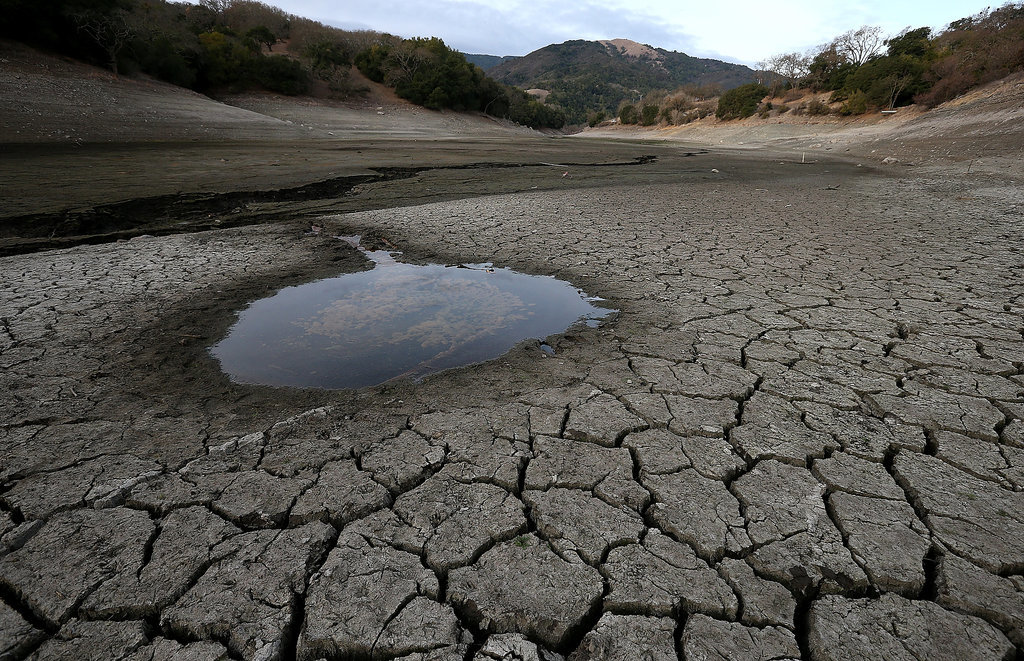
A spokeswoman for General Mills said symptoms of climate change are already having an effect on food production, pointing to extreme and volatile weather conditions and the decline in pollinating insects. A dramatic example of this is the drought in California, which threatens a large parts of the United States’ agriculture industry.
This fear of a hungry future is visible in the company’s climate action plan. In addition to investing $100 million in cleaner energy in its own operations, General Mills will encourage its partners to use “climate-resilient” soils.
READ MORE: California drought worst in 1,200 years – study
John Church, General Mills’ senior vice president of global supply chain, told Minnesota Public Radio that the company is also working with its milk suppliers to cut greenhouse gas emission through better management of cattle.
"Our biggest greenhouse gas contributing ingredient is dairy, milk," he said. "In that supply chain, it's because the cows themselves create methane in their digestive process."
These climate-conscious moves reflect a growing trend of corporations making environmental pledges. In 2014, General Mills became a member of Business for Innovative Climate and Energy Policy (BICEP), a policy advocacy group that lobbies to pass climate change and energy legislation, joining competitors such as Nestle and Kellogg’s.

RT
read more...

10/30/2014

The Weather Channel officially endorses man-made climate change

The Weather Channel just came out with its official position statement on man-made climate change: it’s happening.
The Weather Channel wasn’t exactly waffling on climate change before — it’s been known to produce some great content on that and other environmental issues, along with a wide array of what it calls “weather adjacent” clickbait. The statement, instead, was clearly timed to deal with the latest media fiasco that resulted after Fox News gave a platform to John Coleman, a climate denier who uses his severed connection to the network to spread his fringe theories.
Coleman’s interview with host Megyn Kelly lead to this PR disaster:

Just as there’s a large and significant difference between weather and climate, meteorologists are not climate scientists; as a whole, they tend to be more skeptical of climate science, and sites like the ones pictured above tend to jump on that skepticism as “proof” that the science isn’t nearly as settled as some would have you think. Coleman, despite spending years as a weather forecaster, was never formally trained as a meteorologist; what’s more, his beef isn’t with any particular studies, but with climate scientists themselves, who, he wrote back in 2010, “look askance at the rest of us, certain of their superiority. They respect government and disrespect business, particularly big business. They are environmentalists above all else.”
The writers and editors at the Weather Channel’s website aren’t meteorologists, either. But while they recognize that the science is still out on the relationship between large-scale climate change and local weather events, they’re explicitly clear about where they stand:
The bottom line is that with the rate of greenhouse gas emissions increasing, a significant warming trend is expected to also continue. This warming will manifest itself in a variety of ways, and shifts in climate could occur quickly, so while society needs to continue to wrestle with the difficult issues involved with mitigation of the causes of global warming, an increased focus should be placed on resiliency and adaptation to the effects of global warming given the sensitivity of civilizations and ecosystems to rapid climate change.
 Salon
read more...

4/26/2014

Drought covers 100% of California


A prolonged period of below-average rainfall has put the entire state of California under some level of drought, ranging in severity from moderate to exceptional, for the first time in 15 years.
The latest drought monitor released by the National Climatic Data Center this week shows that the entire state is under moderate drought conditions, but within that map, 76.6% of the state is experiencing extreme drought conditions, and for 24.7% of the state, the level of dryness is "exceptional."
During the same period last year, none of the state was considered to be under extreme or exceptional drought conditions, and just 30% fell under the "severe" category, according to the assessment released Thursday.
“This is a really serious situation here in California and people need to be cognizant of that and start conserving water as much as they can,” said Jayme Laber, a hydrologist with the National Weather Service who is part of a team of scientists who contribute to the weekly drought monitor.
The lack of substantial precipitation over the last three rain seasons has affected every part of the state, "some worse than others," Laber said.
While many municipalities across the state have instituted voluntary conservation measures, some have gone further. As of May 1, customers in Santa Cruz will have to cut their water use by 25% or face stiff financial penalties. The mandatory restrictions are the first for the city in 25 years, CBS San Francisco reported.
The statewide situation eased somewhat after soaking rains in Northern California earlier this year allowed the State Water Project, which supplies a majority of the state, to announce that it would make 5% of the system's allocation -- a minor bump from the zero allocation that customers had been expecting.
Still, NOAA reported last week that half of the Sierra Nevada’s snowpack liquid water equivalent melted in one week, spurred by statewide temperatures that were as much as 12 degrees above average. The melt did little to boost reservoirs.


Video: 100% of California is in Drought


Source: LA Times

read more...

5/30/2013

Mount Everest region glaciers retreating as climate warms

This undated photograph shows unidentified mountaineers as they walk past the Hillary Step whilst pushing for the summit of Mount Everest as they climb the south face from Nepal. (TSHERING SHERPA , AFP/GETTY IMAGES)
Even the world’s tallest mountain – first conquered by man 60 years ago today – cannot escape climate change.
A recent study led by a graduate student at the University of Milan in Italy reveals declining snow amounts and retreating glaciers in the Mount Everest region, reaffirming fears that many scientists hold – increasing global temperatures could cause irreversible damage.
The research presented at an American Geophysical Union (AGU) conference in Mexico earlier this month, shows that the glaciers in the Everest region have shrunk by 13 percent over the last 50 years.
The snowline has also moved uphill nearly 580 feet.

read more...

5/16/2013

Scientists Agree: Climate Change Is Happening

Public opinion on the topic of climate change is notoriously fickle, changing -- quite literally sometimes -- with the weather. The latest bit of evidence on this: Yale's April 2013 climate change survey, which found, among other things, that Americans' conviction that global warming is happening had dropped by seven points, to 63 percent, over the preceding six months. The decline, the authors surmised, was most likely due to "the cold winter of 2012-13 and an unusually cold March just before the survey was conducted."
A far smaller percentage -- 49 percent -- understood that human activities are contributing to the problem.
People and surveys being what they are, these numbers tend to jump around a bit from year to year. At the same time, 49 percent is nearly half the country, so it wouldn't be excessively cheerful (would it?) to note that half of the American public is more or less in harmony with basic science -- at least as it relates to climate change. Given that roughly the same number of Americans flatly reject evolution, the climate numbers represent a comparative bounty of enlightenment.
That's not something you hear very often when it comes to surveys of Americans. Delving deeper into the textbooks, for instance, another recent study showed that less than half of population was clear on whether atoms are smaller than electrons, or whether lasers work by focusing sound waves. In this light (ahem), the larger consensus on global warming is notable. (Answers on atoms and lasers appear at the end of this column.)
climate change
It's elementary: climate change is real.
But a far more troubling metric from Yale's latest poll suggests that only 42 percent of Americans believe that most scientists think global warming is happening. A full 33 percent of respondents are convinced that there remains "widespread disagreement" among scientists on this question. This is a problem -- both because it is so at odds with reality, and because it likely helps prevent more Americans from recognizing and accepting some pretty straightforward scientific realities.
It is this reason that prompted a team of researchers to painstakingly comb through the abstracts of more than 12,000 scientific articles published between 1991 and 2011 to determine just how much scientific agreement exists on the subject of climate change, and humanity's role in driving it. The team was led by John Cook, a Climate Communication Fellow for the Global Change Institute at the University of Queensland and the founder of the climate change education web site SkepticalScience.com.

read more...

10/30/2012

New York wakes up to devastation after superstorm Sandy

Cars are submerged at the entrance to a parking garage in New York's Financial District in the aftermath of superstorm Sandy. Picture: Richard Drew
NEW York has awoken in shock to a city devastated by deadly superstorm Sandy, which killed at least 10 people and threatened to leave days of chaos in its wake. A record tidal surge thrown up by the hurricane set off an explosion at a power station, fire destroyed dozens of homes in the Queens district and a major hospital had to evacuate more than 200 patients at the height of the storm. Subway trains and buses remained suspended for a third day and hundreds of thousands of homes face up to a week without electricity, the power company warned.

read more...

10/16/2012

World record matched for hottest September since 2005

An aerial view of New Yorkers taking in the sun on a beach at Coney Island. The past year has been the hottest since modern record-keeping started in 1895. AFP
SOMETHING about September keeps bringing out the record heat in the world.
 
The globe last month matched a record for the hottest September, set in 2005.
It was the third time since 2000 that the world set or tied a heat record for September. In addition to 2012 and 2005, previous hot September records were set in 2003. And these records go back to 1880.

Last month's average temperature was 60.2 degrees Fahrenheit (15.6 degrees Celsius) worldwide, which is 1.2 degrees above normal, the National Oceanic and Atmospheric Administration said yesterday.

NOAA climate monitoring chief Deke Arndt said it may be worth studying why September, more than other months, keeps setting world records. It might be the lengthening of the Northern Hemisphere summer as a result of man-made global warming and continual loss of Arctic sea ice that indirectly helps cool other parts of the world, said University of Victoria climate scientist Andrew Weaver.

read more...

10/08/2012

Scientists blame warmer Atlantic for wet summers

Recent warming in the Atlantic Ocean is the main cause of wet summers in northern Europe, according to a new study.
A cyclical pattern of rising and falling ocean temperatures is seen as a major influence on our weather.
Scientists say the current pattern will last as long as the Atlantic warming persists.
The research was carried out at the University of Reading and is published in the journal Nature Geoscience.
The study investigated a phenomenon known as the Atlantic Multidecadal Oscillation - a cycle of change in which the waters either warm or cool over a period of several decades.

read more...

9/20/2012

Sea Surface Temperatures Reach Record Highs off Northeast Coast

During the first six months of 2012, sea surface temperatures in the Northeast Shelf Large Marine Ecosystem were the highest ever recorded, according to NOAA's Northeast Fisheries Science Center.
The Northeast Continental Shelf Large Marine Ecosystem (LME) extends from the Gulf of Maine to Cape Hatteras, N.C.
The average sea surface temperature (SST) exceeded 51.0 degrees F during the first half of 2012, breaking the previous record high set in 1951. For the past three decades, the average SST has been 48 degrees F.
In some nearshore locations such as the Delaware and Chesapeake bays in the Middle Atlantic Bight region, temperatures were more than 11 degrees F above historical average at the surface and more than 9 degrees F above average at the bottom.
"A pronounced warming event occurred on the Northeast Shelf this spring, and this will have a profound impact throughout the ecosystem," said Kevin Friedland, a scientist in the NEFSC's Ecosystem Assessment Program.

read more...

7/15/2012

Bad weather affects bird migration

Curlews are in sharp decline in Wales
Unpredictable weather has altered bird migration patterns, with many arriving in Wales weeks earlier than expected, say experts.
The National Wetland Centre in Llanelli said 800 curlews, not normally seen until late August, were early arrivals.
About 100 redshank, 90 oystercatcher and 190 black-tailed godwit had also flown in early.
The Wildfowl and Wetlands Trust (WWT) said the weather also affected breeding patterns.
Another reason for the birds' early arrival might be that some of them failed to breed in Iceland.
Pamela Styles, the WWT's learning assistant at Llanelli, said: "2012 has been a year of unpredictable weather, and many birds have already been affected.

read more...

7/12/2012

Latest signs of a worsening drought

Add captionA dock extends into a dry cove at Morse Reservoir in Noblesville, Ind., on July 5. The central Indiana reservoir is down 3.5 feet from normal levels. Michael Conroy / AP file
From exploding hay bales to a sprinkler ban in Indianapolis, the Midwest and Plains states continue to be tested by a hot, dry summer.
A drought update Thursday didn't offer much hope either: 61 percent of the contiguous U.S. was listed in drought, up from 56 percent last week, according to the National Weather Service's Drought Monitor.
"Anytime we have a drought maturing in mid-summer, the chances for rapid intensification will be there," Gary McManus, Oklahoma's associate state climatologist, told msnbc.com. "Even normal heat and dry conditions can speed that drought along."

read more...

Northeast Brazil reels from worst drought in 30 years

The worst drought to hit Brazil's impoverished northeast in 30 years is wreaking havoc among thousands of local farmers, including small producers like Jose Holanda de Moraes who have lost entire harvests.

"Last year, I produced 800 kilograms (1,763 pounds) of cotton, 300 kilos of sesame and 400 kilos of black beans," said de Moraes, a 43-year-old farmer near Apodi in Rio Grande do Norte state.

"This year I planted seeds but it did not rain and I lost everything," he said.

De Moraes farms 19 hectares (47 acres) in the village of Moacir Lucena right in the heart of the semi-arid Sertao hinterland where less than 150 millimeters of rain fell in the first half of this year.

In 1999, the government confiscated some land in the area and redistributed it to landless peasants as part of an agrarian reform program.

The Sertao, a region known as the "Drought Polygon," covers the northeastern states of Piaui, Ceara, Rio Grande do Norte, Paraiba, Pernambuco, Alagoas, Sergipe and Bahia.

The area is covered by a distinctive scrubby vegetation consisting mainly of low thorny bushes adapted to the arid climate.

read more...

5/09/2012

Warmest May to April ever for U.S


(Reuters) - The contiguous U.S. states posted record warmth from May 2011 through April, and drought conditions spread across more than a third of this area during the first months of 2012, the National Oceanic and Atmospheric Administration NOAA.L said on Tuesday.
The contiguous United States had a national average temperature of 55.7 F (13.2 C) from May 2011 to April 2012, 2.8 F (1.6 C) above the 20th century average, NOAA said in a statement.
It was the warmest ever May-to-April period in the lower 48 states. It included the second-hottest summer, fourth-warmest winter and the warmest March. Twenty-two states posted record warmth for the period.
The first four months of the 2012 were the warmest on record. The average temperature for the contiguous states during these months was 45.4 F (7.4 C), 5.4 F (3 C) above normal.

read more...

4/05/2012

20 million hit by drought in southeast England

Justin Tallis / AFP - Getty Images
A wooden branch lies in the dry mud at the bank of the half-full Bewl Water reservoir in the English county of Kent on Thursday. Charlie Powell, a meteorologist at the U.K.'s Met Office, told msnbc.com there was no sign of an imminent downpour over England's drought-affected areas.
London has an undeserved reputation as a rainy city, with “things to do” when the U.K. capital is wet a popular topic of conversation among tourists.
But this year could see that image shattered in dramatic fashion, with much of southeast England gripped by a serious drought currently affecting about 20 million people.

read more...

3/19/2012

What Happened to Winter?

The Stidman family, Fil, Anna, and their daughters Laura, back left, and Sarah, of Raleigh, N.C. enjoy the warm Washington weather underneath a blooming magnolia tree on the Capitol grounds, March 12, 2012. (Manuel Balce Ceneta/AP Photo)
The winter of 2011-12 might well earn the title of "the winter that wasn't" in many parts of the United States.
The season has entered the books as the fourth warmest on record for the Lower 48, according to an analysis by the National Climatic Data Center in Asheville, N.C.
In January, for instance, daily high-temperature records were broken across the northern Plains. Minot, N.D., posted a 61 degree F. high on Jan. 5, eclipsing the previous record of 58 degrees set in 1906.
Despite several powerful snowstorms that crossed the continent during the season, the extent of the country blanketed with snow was the third smallest since satellites began keeping track 46 years ago. The amount of rain was also below normal.
What a contrast with the winter before. Who could forget the seemingly endless conga line of storms that traversed the country? That winter also was somewhat colder than normal, which meant the snow didn't melt significantly between storms, explains Jeff Weber, a meteorologist at the National Center for Atmospheric Research (NCAR) in Boulder, Colo.

read more...

3/16/2012

Record-breaking warm weather advances beginning of growing season

Fig 1
Recent abnormally warm weather has resulted in a very early start to the growing season across the Great Lakes Region and much of the central and eastern USA. The trend towards warmer than normal conditions is not new, with above normal mean temperatures observed across Michigan during much of the period back to the middle of last November. The winter of 2011-2012 (December through February) was the fourth mildest on record.

The prolonged warm spell is the result of a very persistent jet stream configuration across North America that generally prevented cold, arctic-origin air masses from moving out of their high-latitude source regions southward into the central and eastern USA. This left the area under the influence of relatively mild Pacific-origin air masses. The current jet stream pattern, with deep troughing across the western USA and ridging across the east has accentuated the pattern. The result is record-breaking warmth brought northward from the Gulf States on southerly winds.

read more...

2/28/2012

Climate change may increase risk of water shortages in hundreds of US counties by 2050

More than 1 in 3 counties in the United States could face a "high" or "extreme" risk of water shortages due to climate change by the middle of the 21st century, according to a new study in ACS's Journal of Environmental Science and Technology.
The new report concluded that 7 in 10 of the more than 3,100 U.S. counties could face "some" risk of shortages of fresh water for drinking, farming and other uses. It includes maps that identify the counties at risk of shortages.
In the analysis, Sujoy B. Roy, Ph.D., and colleagues explain that population growth is expected to increase the demand for water for municipal use and for electricity generation beyond existing levels.
Global climate change threatens to reduce water supplies due to decreased rainfall and other factors compared to levels in the 20th century.
Roy's group developed a "water supply sustainability risk index" that takes into account water withdrawal, projected growth, susceptibility to drought, projected climate change and other factors in individual U.S. counties for the year 2050.
It takes into account renewable water supply through precipitation using the most recent downscaled climate change projections and estimates future withdrawals for various human uses.
Roy's team used the index to conclude that climate change could foster an "extreme" risk of water shortages that may develop in 412 counties in southern and southwestern states and in southern Great Plains states.
"This is not intended as a prediction that water shortages will occur, but rather where they are more likely to occur, and where there might be greater pressure on public officials and water users to better characterize, and creatively manage demand and supply," Roy said.

Source: Terra Daily
read more...

2/02/2012

Arctic Is Already Suffering the Effects of a Dangerous Climate Change

Two decades after the United Nations established the Framework Convention on Climate Change in order to “prevent dangerous anthropogenic interference with the climate system,” the Arctic shows the first signs of a dangerous climate change. (Credit: Image courtesy of CSIC, Consejo Superior de Investigaciones Científicas)
ScienceDaily (Jan. 30, 2012) — Two decades after the United Nations established the Framework Convention on Climate Change in order to "prevent dangerous anthropogenic interference with the climate system," the Arctic shows the first signs of a dangerous climate change. A team of researchers led by CSIC assures so in an article recently published in Nature Climate Change 
These researchers assert that the Arctic is already suffering some of the effects that, according to The Intergovernmental Panel on Climate Change (IPCC), correspond with a "dangerous climate change." 

read more...

12/14/2011

Big climate change could happen fast - and soon

New research from NASA into the Earth's paleoclimate history indicates we could be facing rapid climate change this century, including sea level rises of many meters.
And while international leaders have suggested a goal of limiting global warming to two degrees Celsius from pre-industrial times, Goddard Institute for Space Studies director James E Hansen says that even this would lead to drastic changes.

read more...

12/01/2011

Permafrost loss worse climate peril than thought

The threat to climate change posed by thawing permafrost, which could release stocks of stored carbon, is greater than estimated, a group of scientists said on Wednesday.
By 2100, the amount of carbon released by permafrost loss could be "1.7-5.2 times larger than those reported," depending on how swiftly Earth's surface warms, they said.
In volume terms, this is about the same as the amount of greenhouse gases released today from deforestation, they said.
But the impact on climate could be 2.5 times greater, as much of the gas will be methane, which is 25 times more efficient at trapping solar heat than carbon dioxide (CO2), they said.

read more...
 
Copyright © 2018 Great Red Comet-Earth Science Chronicles • All Rights Reserved.
Template Design by BTDesigner • Powered by Blogger
back to top