Featured Story

Mangroves move inland as seas rise

Adapting to the damaging effects of climate change, plants are gradually moving to where temperatures are cooler, rainfall is greater, f...

Showing posts with label Drought. Show all posts

7/12/2012

Latest signs of a worsening drought

Add captionA dock extends into a dry cove at Morse Reservoir in Noblesville, Ind., on July 5. The central Indiana reservoir is down 3.5 feet from normal levels. Michael Conroy / AP file
From exploding hay bales to a sprinkler ban in Indianapolis, the Midwest and Plains states continue to be tested by a hot, dry summer.
A drought update Thursday didn't offer much hope either: 61 percent of the contiguous U.S. was listed in drought, up from 56 percent last week, according to the National Weather Service's Drought Monitor.
"Anytime we have a drought maturing in mid-summer, the chances for rapid intensification will be there," Gary McManus, Oklahoma's associate state climatologist, told msnbc.com. "Even normal heat and dry conditions can speed that drought along."

read more...

Northeast Brazil reels from worst drought in 30 years

The worst drought to hit Brazil's impoverished northeast in 30 years is wreaking havoc among thousands of local farmers, including small producers like Jose Holanda de Moraes who have lost entire harvests.

"Last year, I produced 800 kilograms (1,763 pounds) of cotton, 300 kilos of sesame and 400 kilos of black beans," said de Moraes, a 43-year-old farmer near Apodi in Rio Grande do Norte state.

"This year I planted seeds but it did not rain and I lost everything," he said.

De Moraes farms 19 hectares (47 acres) in the village of Moacir Lucena right in the heart of the semi-arid Sertao hinterland where less than 150 millimeters of rain fell in the first half of this year.

In 1999, the government confiscated some land in the area and redistributed it to landless peasants as part of an agrarian reform program.

The Sertao, a region known as the "Drought Polygon," covers the northeastern states of Piaui, Ceara, Rio Grande do Norte, Paraiba, Pernambuco, Alagoas, Sergipe and Bahia.

The area is covered by a distinctive scrubby vegetation consisting mainly of low thorny bushes adapted to the arid climate.

read more...

6/23/2012

Colorado farmers are facing disaster


WELD COUNTY - Glenn Fritzler's family has been farming their 320 acres for 57 years. It is productive land that has helped them build their family. To succeed here, it took hard work, good soil and one thing they can't do without: water.
"Water to us is actually more valuable than gold," Fritzler said.
In recent years, that has not been a problem. Heavy snows and rains allowed Fritzler and other farmers in Weld County to irrigate their fields with surface water from the South Platte River. This year is different.
Because of the dry winter and spring the South Platte River is not flowing at a level to allow farmers, like Fritzler, to continue to use it as an irrigation source. Unless conditions change Fritzler will not receive any more above surface water for their crops.
"We have no surface water," Fritzler said. "We have an abundance of groundwater, but we do not have the permission to use it."

read more...

4/05/2012

20 million hit by drought in southeast England

Justin Tallis / AFP - Getty Images
A wooden branch lies in the dry mud at the bank of the half-full Bewl Water reservoir in the English county of Kent on Thursday. Charlie Powell, a meteorologist at the U.K.'s Met Office, told msnbc.com there was no sign of an imminent downpour over England's drought-affected areas.
London has an undeserved reputation as a rainy city, with “things to do” when the U.K. capital is wet a popular topic of conversation among tourists.
But this year could see that image shattered in dramatic fashion, with much of southeast England gripped by a serious drought currently affecting about 20 million people.

read more...

8/04/2011

Southern States Bake in Extreme Heatwave

Texas suffers in heat, sets electricity record

The swath of states across the southern U.S. burned hot on Wednesday: Little Rock, Ark., beat its all-time record, reaching 114 degrees. Sweltering Texas saw a third-straight day of record electricity usage. Phoenix, Ariz., also saw triple digits — and the possibility of yet another dust storm.
Little Rock topped its earlier record, set in 1986, by two degrees.
In Texas, the power-grid operator urged residents to conserve electricity or face the prospect of rolling blackouts.

read more...

7/28/2011

1.5 million bats in Texas city left hungrier by drought

Some of 1.5 million bats that live under an Austin, Texas, bridge are seen on July 26, 2011
There are 1.5 million bats living under a bridge in downtown Austin, and a historic Texas drought is making them hungrier than ever.That's bad news for the bats in the world's largest urban bat colony. But it is good news for the humans who gather each evening just a few blocks from the state Capitol building to watch their spectacular nightly trips into the nearby Hill Country to find food.
The drought has killed off crops in Texas, and that in turn has killed off those delicious pests the Mexican free-tailed bats consider dinner.
That means they have to leave home earlier than usual each night to find nourishment — giving the locals in this bat-crazy city a precious few more minutes to watch the normally-nocturnal critters fly before the sun goes down.
Each night they stream from under a bridge by the hundreds of thousands in a black cloud so large that it shows up on local weather radar.

read more...

5/12/2011

2,300-year climate record suggests severe tropical droughts as northern temperatures rise

The study compared the record in the Pumacocha sediment core (PC) to various geological records from South America -- Cascayunga Cave (CC), the Quelccaya ice Cap (QIC), and the Cariaco...


Click here for more information.

A sediment core from a South American lake revealed a steady, sharp drop in crucial monsoon rainfall since 1900, leading to the driest conditions in 1,000 years as of 2007 and threatening tropical populations with water shortages.

PITTSBURGH—A 2,300-year climate record University of Pittsburgh researchers recovered from an Andes Mountains lake reveals that as temperatures in the Northern Hemisphere rise, the planet's densely populated tropical regions will most likely experience severe water shortages as the crucial summer monsoons become drier. The Pitt team found that equatorial regions of South America already are receiving less rainfall than at any point in the past millennium.
The researchers report in the Proceedings of the National Academy of Sciences (PNAS) that a nearly 6-foot-long sediment core from Laguna Pumacocha in Peru contains the most detailed geochemical record of tropical climate fluctuations yet uncovered. The core shows pronounced dry and wet phases of the South American summer monsoons and corresponds with existing geological data of precipitation changes in the surrounding regions.
Paired with these sources, the sediment record illustrated that rainfall during the South American summer monsoon has dropped sharply since 1900—exhibiting the greatest shift in precipitation since around 300 BCE—while the Northern Hemisphere has experienced warmer temperatures.
Study coauthor Mark Abbott, a professor of geology and planetary science in Pitt's School of Arts and Sciences who also codesigned the project, said that he and his colleagues did not anticipate the rapid decrease in 20th-century rainfall that they observed. Abbott worked with lead author and recent Pitt graduate Broxton Bird; Don Rodbell, study codesigner and a geology professor at Union College in Schenectady, N.Y.; recent Pitt graduate Nathan Stansell; Pitt professor of geology and planetary science Mike Rosenmeier; and Mathias Vuille, a professor of atmospheric and environmental science at the State University of New York at Albany. Both Bird and Stansell received their PhD degrees in geology from Pitt in 2009.


read more...

12/10/2010

"Alarming" Amazon Drought—River Hits New Low

Hard-hit by a months-long drought, a waterway within the Amazon Basin trickles to a halt in Manaus, Brazil (see map), on November 19.  SEE PHOTOS

The Negro River, a major tributary of the Amazon River, dropped to a depth of about 46 feet (14 meters)—the lowest point since record-keeping began in 1902.
(Related: "Amazon Losing 'Flying Rivers,' Ability to Curb Warming.")

About 60,000 people in the Amazon have gone hungry as falling river levels paralyzed transport and fishing. Millions of dead fish have also contaminated rivers, leading to a shortage of clean drinking water, the Reuters news agency reported.

Caused by El Niño—a cyclical warming of tropical waters in the central and eastern Pacific Ocean—such a severe drought usually occurs once in a century. But the 2010 disaster comes just five years after the latest Amazon "megadrought," according to Reuters.

The drought also fits within predictions of climatic extremes this century due to global warming, Reuters reported. (Explore an interactive map of global warming's effects.)

Published December 6, 2010

Waiting for Rain: The Politics and Poetry of Drought in Northeast Brazil 
read more...

10/21/2010

Drought may threaten much of globe within decades

The United States and many other heavily populated countries face a growing threat of severe and prolonged drought in coming decades, according to results of a new study by National Center for Atmospheric Research (NCAR) scientist Aiguo Dai.
The detailed analysis concludes that warming temperatures associated with climate change will likely create increasingly dry conditions across much of the globe in the next 30 years.
The drought may reach a scale in some regions by the end of the century that has rarely, if ever, been observed in modern times.

read more...

9/21/2010

Drought shrinks Amazon River to lowest level in 47 years

A severe drought parching northern Brazil this year has shrunk the mighty Amazon River -- the world's longest river -- to its lowest level in 47 years, officials said Wednesday.
The waterway's depth at Manaus, the main city in the Amazon region, was just 19.34 meters (63.45 feet) -- well below its average of 23.25 meters (76.28 feet), the country's Geological Service told AFP.
The last time the river was at such a low level was in 1963.
Scientists say it appears Brazil is headed for its worst drought since that year. Final data to be collected up to October were expected to confirm that.

read more...

4/01/2010

China attempts inducing rain for drought

BEIJING, March 30 (UPI) -- In an attempt to bring relief to drought-stricken southwestern China, the government fired cannons and launched rockets loaded with cloud-seeding chemicals throughout the weekend.
Results ranged from drizzle to moderate rain to downpours in 11 cities and prefectures, yet meteorologists said the induced rain would have a limited effect on China's worst drought in a century.

In the Chuxiong Yi autonomous prefecture of Yunnan, the scant rain wasn't enough to produce a flow of surface and ground water and had no effect on the water supply in wells or reservoirs. So the drinking water shortage will continue, a chief weather forecaster told China Daily.

China's drought has affected 61.3 million people and more than 12 million acres of crops in the provinces of Guizhou, Yunnan, Sichuan, Chongqing, and Guangxi, the Ministry of Civil Affairs said last week.
read more...

12/07/2009

The New Dust Bowl


The Central Valley, the thin, fertile band running down the middle of California, has long boasted the world's richest agricultural economy, reliably producing more than a quarter of the nation's fruits, nuts, and vegetables. But it's done so in defiance of ecological reality. The 70-year-old irrigation system that has pumped water into the otherwise arid valley is proving increasingly vulnerable to shifting weather patterns. It now appears that waterwise, 20th century California was an anomaly, a relatively wet period in the midst of a historical cycle of severe drought.

And the changing climate will only magnify the problem: By the end of the century, scientists predict, Central California could experience temperatures rivaling Death Valley's and face the loss of 90 percent of the Sierra Nevada snowpack, the region's main water source. "Business as usual won't work in the future," says Eike Luedeling, an expert in plant sciences at the University of California-Davis, whose research shows that higher temperatures will likely decimate the state's $10 billion fruit and nut industry. "Especially for tree crops, adapting will require huge investments that probably a lot of small guys can't make anymore."

The sudden collapse of the Central Valley's economy illustrates how climate change can push a fragile region over the edge. Already vulnerable from rampant housing speculation and a dependence on industrial agriculture, the valley never prepared for a prolonged spate of bad weather. In 2008, local bankruptcy filings jumped 74 percent—from about 15,300 to 27,000—a rate of increase twice the national average. Three of the valley's counties were among the nation's six worst for foreclosures, with nearly 85,000 houses lost. The drought is expected to dry up a billion dollars in income and 35,000 jobs, adding to a statewide unemployment rate that recently hit 11.9 percent—the highest since the eve of World War II. Gov. Arnold Schwarzenegger has asked the federal government to declare the region a disaster area.

On the west side of the valley, which is often last in line for deliveries from federal water projects, farmers are selling prized almond trees for firewood, fields are reverting to weed, and farmworkers who once fled droughts in Mexico are overwhelming food banks. In short, the valley is becoming what an earlier generation of refugees thought they'd escaped: an ecological catastrophe in the middle of a social and economic one—a 21st century Dust Bowl.
read more...

9/25/2009

India heading for worst drought since 1972

NEW DELHI — India's monsoon was about 20 percent below strength just over a week before the official end of the rainy reason, putting the country on course for its worst drought since 1972, weather data showed Wednesday.
"Until September 21, for the country as a whole, the rain deficiency was 22 percent," said B.K. Bandopadhyay, a spokesman for the weather office.
"We expect the total rain deficiency will be roughly about 20 percent (at the end of the monsoon season). It depends on the rainfall, but it seems it will be around this number," he added.
Low rainfall early in the monsoon period ravaged India's rice, cane sugar and groundnut crops, and has disrupted the flow of water into the main reservoirs that are vital for hydropower generation and winter irrigation.
The drought is expected to dampen India's economic growth this year and has sent food prices rocketing, leading to huge hardship for India's poor masses.
read more...

9/14/2009

Mexico Now Enduring Worst Drought in Years

Mexico is enduring its worst drought in six decades. Crops are drying up in the fields and water is being rationed in the capital. Residents of poor neighborhoods have hijacked water trucks, and there are other signs of social tensions building. Image: DRY STATE A farmer rode past a carcass in Tabasco State, which has lost about 7,000 animals.

El Niño, a weather pattern that warms water in the Pacific Ocean and leads to changing weather around the Pacific Basin, is causing the drought, Mexican officials say.

The rainy season typically begins here in June. Rain falls almost daily in most of the country, irrigating the spring planting and filling reservoirs before the dry months. But this year, the first three months of the rainy season were dry. Officials warned that the reservoirs were falling to dangerously low levels.

In Mexico, almost 40 percent of the farm land inspected by the government has been affected by the drought, causing shortfalls in the harvests of corn, beans, wheat and sorghum. The Mexican government is spending more than $100 million to buy emergency crop insurance and to dispense direct aid to farmers.
The drought has forced the 20 million residents of Mexico City and its suburbs to confront the vulnerability of their water supply.

The Aztecs built Mexico City, or Tenochtitlán, on an island within a network of shallow lakes. Dykes and canals regulated the flow of water across the vast basin and held back floodwaters.

But the Spanish conquerors set about draining the lakes, and a century ago, the city began to extract water from wells drilled to the water table below. About 70 percent of Mexico City’s water is now pumped out of the aquifer at a rate more than twice as fast as rainfall is able to replenish it.
read more...

8/25/2009

Despair as drought cripples ‘Australia’s Mississippi’

COBRAM, Australia: Farmer Mazzareno Bisogni fights back tears as he stands among the remains of trees he planted 35 years ago, victims of a drought hitting ‘Australia's Mississippi’.
Image Below: This photo taken on May 26, 2009 shows algae along the Murray River at Albury on May 26, 2009, as the continuing drought affects the river which supplies irrigation to Australia's food bowl region, some 300 kilometres north of Melbourne. — AFP
Bisogni's orchard lies in the heart of the once-mighty Murray-Darling river system which irrigates Australia's food bowl, the vast southeastern corner responsible for 40 per cent of agricultural output.
The eight-year 'big dry', the worst drought in a century, has devastated the region, an area covering 1.06 million square kilometres — the size of France and Spain combined.
Lack of water this year meant the fruit on Bisogni's apple and pear trees in Victoria state literally cooked on their branches under the furious Australian sun, making them suitable only for jam.
Sections of the river have become little more than stagnant pools as the drought continues, with banks eroded into crumbling dirt cliffs that leave the roots of gum trees exposed.
For three months this year, a toxic blue-green algal bloom leeched along 800 kilometres of the Murray, prompting warnings from authorities not to swim in the river.
Water levels are so low that the freshwater lakes near the Murray's mouth in South Australia are turning acid as soil minerals are exposed to oxygen. The lakes are now below sea-level and only man-made barriers keep the ocean out.
read more...

6/22/2009

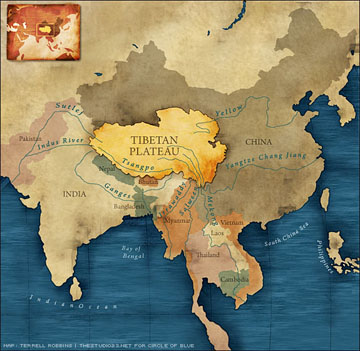
Tibet drought worst in 30 years

A drought in Tibet has intensified into the region's WORST IN THREE DECADES, leaving thousands of hectares parched and killing more than 13,000 head of cattle. The report follows a warning by China's top weather official last month that the Himalayan region faced a growing threat of drought and floods as global warming melts its glaciers. Drought conditions have hit five of Tibet's six prefectures since last year, affecting 15.3 percent of the remote plateau. Some weather stations had not received significant rainfall in 226 days. "The drought has also been worsened by higher than normal temperatures. Tibet has experienced temperatures 0.4 to 2.3 degrees Celsius (0.7 to 4.1 Fahrenheit) higher than normal years." Experts have repeatedly warned of catastrophic consequences downstream if global warming continues to melt the snows and glaciers of mountainous Tibet, source of many of Asia's mightiest rivers.
read more...

6/03/2009

Drought-hit LA, San Diego impose water ban

LOS ANGELES (AFP) — Hit by a severe drought for the third year in a row, Los Angeles and San Diego on Monday imposed tough restrictions on the use of tap water, local officials said.
Los Angeles, the second largest city in the United States with four million residents, hiked prices to encourage users to cut their consumption by 15 percent.
Watering lawns will now only be allowed on Mondays and Thursdays, tightening an earlier ban on watering gardens between 9:00 am and 4:00 pm.
Local officials will patrol the area and those caught flouting the ban could face fines of up to 600 dollars.
In San Diego, some 200 kilometers (120 miles) further south, gardens may only be watered three days a week and only for 10 minutes at a time. Fines for breaking the rules could stretch to 1,000 dollars in the city of 1.3 million residents.
California Governor Arnold Schwarzenegger declared an emergency in his state at the end of February as it was hit by a drought for the third year running.
Spring and summer 2008 were the driest on record in California with 76 percent less rainfall than usual. But precipitation levels have dropped even further since the start of 2009.
read more...

4/17/2009

West Africa faces 'megadroughts'

Severe droughts lasting centuries have happened often in West Africa's recent history, and another one is almost inevitable, researchers say.

Analysis of sediments in a Ghanaian lake shows the last of these "megadroughts" ended 250 years ago.

Writing in the journal Science, the researchers suggest man-made climate change may make the situation worse.

But, they say, the droughts are going to happen again anyway, and societies should begin planning for them.

"It's disconcerting - it suggests we're vulnerable to a longer-lasting drought than we've seen in our lifetime," said Tim Shanahan from the University of Texas in Austin, who led the research team.

"What West Africa won't handle - and neither will California - is the 100-year-long, deep megadrought"
Professor Michael Schlesinger
read more...

3/01/2009

Schwarzenegger declares Calif. drought emergency

SACRAMENTO — Gov. Arnold Schwarzenegger declared a state of emergency Friday because of three years of below-average rain and snowfall in California, a step that urges urban water agencies to reduce water use by 20%.

"This drought is having a devastating impact on our people, our communities, our economy and our environment, making today's action absolutely necessary," the Republican governor said in his statement.

Mandatory rationing is an option if the declaration and other measures are insufficient.

The drought has forced farmers to fallow their fields, put thousands of agricultural workers out of work and led to conservation measures in cities throughout the state, which is the nation's top agricultural producer.

Agriculture losses could reach $2.8 billion this year and cost 95,000 jobs, said Lester Snow, the state water director.
read more...

2/27/2009

Droughts 'may lay waste' to parts of US

The world's pre-eminent climate scientists produced a blunt assessment of the impact of global warming on the US Wednesday, warning of droughts that could reduce the American south-west to a wasteland and heatwaves that could make life impossible even in northern cities. In an update on the latest science on climate change, the US Congress was told that melting snow pack could lead to severe drought from California to Oklahoma. In the midwest, diminishing rains and shrinking rivers were lowering water levels in the Great Lakes, even to the extent where it could affect shipping. "With severe drought from California to Oklahoma, a broad swath of the south-west is basically robbed of having a sustainable lifestyle."

They went on to warn of scorching temperatures in an array of cities. Sacramento in California, for example, could face heatwaves for up to 100 days a year. "We are close to a threshold in a very large number of American cities where uncomfortable heatwaves make cities UNINHABITABLE." The warnings were the first time Congress had been directly confronted with the growing evidence that the impact of climate change will be far more severe than revealed even in the UN's most recent report, in 2007.

The hearing was also the first time senators had been permitted to hear testimony about the dangers to human health from climate change. In 2007, the Bush administration censored testimony from the Centres for Disease Control and Prevention (CDC) on the rise in asthma and other respiratory illnesses, as well as the increasing occurrence of "tropical" parasites. The gathering of climate scientists was designed to give momentum to efforts by the Democratic leadership to press ahead on energy reform. "If we don't do it people are going to die. They are going to get sick and they are going to die. "

Republicans argued that Barack Obama's proposed carbon cap legislation would be costly. "I will certainly oppose raising energy costs on suffering families and workers during an economic crisis when the science says our actions [to combat climate change] will be futile." The Republican minority on the committee also invited testimony from Professor William Happer who is a well-known climate change sceptic. "It's still not as warm as it was when the Vikings settled England."
read more...
 
Copyright © 2018 Great Red Comet-Earth Science Chronicles • All Rights Reserved.
Template Design by BTDesigner • Powered by Blogger
back to top