Featured Story

Mangroves move inland as seas rise

Adapting to the damaging effects of climate change, plants are gradually moving to where temperatures are cooler, rainfall is greater, f...

Showing posts with label Endangered Species. Show all posts

3/16/2016

Wild bees, butterflies and other pollinators are on the path to extinction

Pollinating insects such as bees and butterflies contribute around $29 billion to U.S. agriculture every year, according to a 2010 study by Cornell University. They are responsible for the pollination of hundreds of crops, including apples, almonds, blueberries, asparagus and oranges.

However, an alarming UN report predicts that these pollinating species are on the path to extinction – something that would have a catastrophic impact on global food supplies. According to The Associated Press, the report suggests that we need to take immediate action to prevent the extinction of these species, before it is too late.

The importance of pollinators

Research has shown that the value of insects to agriculture is enormous and irreplaceable, with the continued decline in pollinator populations possibly leading to an increase in global malnutrition according to Science magazine. This is because they support crops that provide an essential food supply to regions of the world that are already suffering from malnutrition and food shortages – meaning that these regions will be hit the hardest by the decline.

The UN warns that, of approximately 20,000 pollinating species, two out of five invertebrate pollinators (such as bees and butterflies) are seeing a huge decline in numbers. This isn't a new decline and is something that scientists have been observing for several years as reported by Global Research.

What is causing the decline in numbers?

Changes to farming practices have meant that the diversity of plant species in any one area is much more restricted and there are fewer wild flowers for pollinators to feed on. This is a huge problem in the U.S. where large expanses of land are dedicated to growing fields of only a single crop.

Meanwhile, the growth of cities and urbanization of our countryside has removed some of the vital habitat for bees and other pollinators, meaning that they need to travel further to find food. The combination of this habitat removal with the impacts of global warming, which is altering the types of plants that are able to grow in different locations, means that our pollinators are actually starving to death.

The decline has also been associated with pesticide use, and NOLA.com has reported that neonicotinoids in particular could be a problem for pollinators. Neonicotinoids are a controversial type of pesticide that attacks the nervous systems of "pests" but is not species specific – meaning that bees and other pollinators are also affected.

In addition to pesticides, herbicides are also playing a part in this decline, with popular agrichemical Roundup, produced by Monsanto, also being linked to the widespread decline of two key pollinators – honeybees and monarch butterflies. This herbicide wipes out many of the plants that pollinators depend upon for food, such as milkweed.

This UN report has taken two years to complete and is the result of the cooperative work of many scientists from around the world. The report, which draws on a variety of scientific studies, states, "The variety and multiplicity of threats to pollinators and pollination generate risks to people and livelihoods. These risks are largely driven by changes in land cover and agricultural management systems, including pesticide use."

Local action is required in multiple countries in order to solve the problem, and government agencies need to give more careful consideration to the way that farming is impacting the land and the way that crop production is managed. In the UK, farmers are now being paid to plant wildflowers in hedge rows and on unused pieces of land in order to provide food for bees, which is something that could also help pollinators in the U.S. if the same incentives were put in place. If you are a keen gardener, you can also play your part by growing your own bee colony, which not only provides you with honey but also helps to ensure that there are enough pollinators around to pollinate the world's food supply for years to come.
read more...

6/20/2015

Earth’s Sixth Mass Extinction Has Begun, New Study Confirms


We are currently witnessing the start of a mass extinction event the likes of which have not been seen on Earth for at least 65 million years. This is the alarming finding of a new study published in the journal Science Advances.
The research was designed to determine how human actions over the past 500 years have affected the extinction rates of vertebrates: mammals, fish, birds, reptiles and amphibians. It found a clear signal of elevated species loss which has markedly accelerated over the past couple of hundred years, such that life on Earth is embarking on its sixth greatest extinction event in its 3.5 billion year history.
This latest research was conducted by an international team lead by Gerardo Ceballos of the National Autonomous University of Mexico. Measuring extinction rates is notoriously hard. Recently I reported on some of the fiendishly clever ways such rates have been estimated. These studies are producing profoundly worrying results.
However, there is always the risk that such work overestimates modern extinction rates because they need to make a number of assumptions given the very limited data available. Ceballos and his team wanted to put a floor on these numbers, to establish extinction rates for species that were very conservative, with the understanding that whatever the rate of species lost has actually been, it could not be any lower.
This makes their findings even more significant because even with such conservative estimates they find extinction rates are much, much higher than the background rate of extinction – the rate of species loss in the absence of any human impacts.
Here again, they err on the side of caution. A number of studies have attempted to estimate the background rate of extinction. These have produced upper values of about one out of every million species being lost each year. Using recent work by co-author Anthony Barnosky, they effectively double this background rate and so assume that two out of every million species will disappear through natural causes each year. This should mean that differences between the background and human driven extinction rates will be smaller. But they find that the magnitude of more recent extinctions is so great as to effectively swamp any natural processes.

Cumulative vertebrate species recorded as extinct or extinct in the wild by the IUCN (2012). Dashed black line represents background rate. This is the ‘highly conservative estimate’. Ceballos et al
The “very conservative estimate” of species loss uses International Union of Conservation of Nature data. This contains documented examples of species becoming extinct. They use the same data source to produce the “conservative estimate” which includes known extinct species and those species believed to be extinct or extinct in the wild.
The paper has been published in an open access journal and I would recommend reading it and the accompanying Supplementary Materials. This includes the list of vertebrate species known to have disappeared since the year 1500. The Latin names for these species would be familiar only to specialists, but even the common names are exotic and strange: the Cuban coney, red-bellied gracile, broad-faced potoroo and southern gastric brooding frog.

Farewell, broad-faced potoroo, we hardly knew ye. John Gould
These particular outer branches of the great tree of life now stop. Some of their remains will be preserved, either as fossils in layers of rocks or glass eyed exhibits in museum cabinets. But the Earth will no longer see them scurry or soar, hear them croak or chirp.
You may wonder to what extent does this matter? Why should we worry if the natural process of extinction is amplified by humans and our expanding industrialised civilisation?
One response to this question essentially points out what the natural world does for us. Whether it’s pollinating our crops, purifying our water, providing fish to eat or fibres to weave, we are dependent on biodiveristy. Ecosystems can only continue to provide things for us if they continue to function in approximately the same way.
The relationship between species diversity and ecosystem function is very complex and not well understood. There may be gradual and reversible decreases in function with decreased biodiversity. There may be effectively no change until a tipping point occurs. The analogy here is popping out rivets from a plane’s wing. The aircraft will fly unimpaired if a few rivets are removed here or there, but to continue to remove rivets is to move the system closer to catastrophic failure.
This latest research tells us what we already knew. Humans have in the space of a few centuries swung a wrecking ball through the Earth’s biosphere. Liquidating biodiversity to produce products and services has an end point. Science is starting to sketch out what that end point could look like but it cannot tell us why to stop before we reach it.
If we regard the Earth as nothing more than a source of resources and a sink for our pollution, if we value other species only in terms of what they can provide to us, then we we will continue to unpick the fabric of life. Remove further rivets from spaceship earth. This not only increases the risk that it will cease to function in the ways that we and future generations will depend on, but can only reduce the complexity and beauty of our home in the cosmos.

IFL Science
The Conversation
read more...

10/03/2014

Earth Has Lost Half of its Wildlife in the Past 40 Years


Species across land, rivers and seas decimated as humans kill for food in unsustainable numbers and destroy habitats. The number of wild animals on Earth has halved in the past 40 years, according to a new analysis. Creatures across land, rivers and the seas are being decimated as humans kill them for food in unsustainable numbers, while polluting or destroying their habitats, the research by scientists at WWF and the Zoological Society of London found. “If half the animals died in London zoo next week it would be front page news,” said Professor Ken Norris, ZSL’s director of science. “But that is happening in the great outdoors. This damage is not inevitable but a consequence of the way we choose to live.” He said nature, which provides food and clean water and air, was essential for human wellbeing.
 “We have lost one half of the animal population and knowing this is driven by human consumption, this is clearly a call to arms and we must act now,” said Mike Barratt, director of science and policy at WWF. He said more of the Earth must be protected from development and deforestation, while food and energy had to be produced sustainably. The steep decline of animal, fish and bird numbers was calculated by analysing 10,000 different populations, covering 3,000 species in total. This data was then, for the first time, used to create a representative “Living Planet Index” (LPI), reflecting the state of all 45,000 known vertebrates. “We have all heard of the FTSE 100 index, but we have missed the ultimate indicator, the falling trend of species and ecosystems in the world,” said Professor Jonathan Baillie, ZSL’s director of conservation.
“If we get [our response] right, we will have a safe and sustainable way of life for the future,” he said. If not, he added, the overuse of resources would ultimately lead to conflicts. He said the LPI was an extremely robust indicator and had been adopted by UN’s internationally-agreed Convention on Biological Diversityas key insight into biodiversity.


A second index in the new Living Planet report calculates humanity’s “ecological footprint”, ie the scale at which it is using up natural resources. Currently, the global population is cutting down trees faster than they regrow, catching fish faster than the oceans can restock, pumping water from rivers and aquifers faster than rainfall can replenish them and emitting more climate-warming carbon dioxide than oceans and forests can absorb.
The report concludes that today’s average global rate of consumption would need 1.5 planet Earths to sustain it. But four planets would be required to sustain US levels of consumption, or 2.5 Earths to match UK consumption levels.
The fastest decline among the animal populations were found in freshwater ecosystems, where numbers have plummeted by 75% since 1970. “Rivers are the bottom of the system,” said Dave Tickner, WWF’s chief freshwater adviser. “Whatever happens on the land, it all ends up in the rivers.” For example, he said, tens of billions of tonnes of effluent are dumped in the Ganges in India every year.
As well as pollution, dams and the increasing abstraction of water damage freshwater systems. There are more than 45,000 major dams – 15m or higher – around the world. “These slice rivers up into a thousand pieces,” Tickner said, preventing the healthy flow of water. While population has risen fourfold in the last century, water use has gone up sevenfold. “We are living thirstier and thirstier lives,” he said.
But while freshwater species such as the European eel and the hellbender salamander in the US have crashed, recoveries have also been seen. Otters were near extinct in England but thanks to conservation efforts nowlive in every county.


The number of animals living on the land has fallen by 40% since 1970. From forest elephants in central Africa, where poaching rates now exceed birth rates, to the Hoolock gibbon in Bangladesh and European snakes like the meadow and asp vipers, destruction of habitat has seen populations tumble. But again intensive conservation effort can turn declines around, as has happened with tigers in Nepal.
Marine animal populations have also fallen by 40% overall, with turtles suffering in particular. Hunting, the destruction of nesting grounds and getting drowned in fishing nets have seen turtle numbers fall by 80%. Some birds have been heavily affected too. The number of grey partridges in the UK sank by 50% since 1970 due to the intensification of farming, while curlew sandpipers in Australia lost 80% of their number in the 20 years to 2005.
The biggest declines in animal numbers have been seen in low-income, developing nations, while conservation efforts in rich nations have seen small improvements overall. But the big declines in wildlife in rich nations had already occurred long before the new report’s baseline year of 1970 – the last wolf in the UK was shot in 1680.
Also, by importing food and other goods produced via habitat destruction in developing nations, rich nations are “outsourcing” wildlife decline to those countries, said Norris. For example, a third of all the products of deforestation such as timber, beef and soya were exported to the EU between 1990 and 2008.
David Nussbaum, chief executive of WWF-UK said: “The scale of the destruction highlighted in this report should be a wake-up call for us all. But 2015 – when the countries of the world are due to come together to agree on a new global climate agreement, as well as a set of sustainable development goals – presents us with a unique opportunity to reverse the trends.
“We all – politicians, businesses and people – have an interest, and a responsibility, to act to ensure we protect what we all value: a healthy future for both people and nature.”

Waking Times
read more...

8/28/2014

Wildlife face a 'biological holocaust'

Half the planet should be set aside solely for the protection of wildlife to prevent the “mass extinction” of species, according to one of the world’s leading biologists.
The radical conservation strategy proposed by Dr E.O. Wilson, the hugely-influential 85-year old Harvard University scientist, would see humans essentially withdraw from half of the Earth.
Dr Wilson, a two-time Pulitzer Prize winner, warned that we are facing a “biological holocaust” as devastating as the extinction of the dinosaurs unless humans agree to share land more equally with the planet’s 10 million other species.
Outlining his audacious “Half Earth” theory, he said: “It’s been in my mind for years that people haven’t been thinking big enough – even conservationists.
“I see a chain of uninterrupted corridors forming, with twists and turns, some of them opening up to become wide enough to accommodate national biodiversity parks, a new kind of park that won’t let species vanish,” he told the journal of the Smithsonian Institution in Washington.
Dr Wilson, who is considered the world’s preeminent advocate of biodiversity, wants to create a series of “Long Landscape” wildlife chains to help species to respond to the effects of climate change by moving around.
These “corridors” running vertically down continents will let species move north as temperatures rise, for example, while those going horizontally will enable species to move east as rainfall declines in the west, Dr Wilson said.
He pointed to the Yellowstone-to-Yukon conservation initiative running 2,000 miles from Wyoming in the mid-west of the US to the Yukon territories in the north west of Canada as a good example of the kind of protected area he would like to see become extremely widespread. The area encompasses and protects an entire mountain eco-system, giving species 502,000 square miles of uninterrupted land to roam.
Scale is important because “islandisation” can have a disastrous impact on wildlife, according to Dr Wilson, whose theory of island biogeography is regarded as the authoritative explanation for why confined landscapes inevitably lose species.
Small areas can become islands, and without ‘bridges’  to connect them to similar habitats, species are more likely to become extinct. This is partly because wildlife need to draw from a broad gene pool to avoid the “genetic anomalies” that become more likely when breeding with relatives.
Furthermore, island populations are disproportionately vulnerable to disease, over hunting or catastrophic events like floods or fires and linking habitats together provides a life-line by helping the movement of species and their genes, scientists say.
Dr Wilson’s career has earned him huge credibility. But observers say he will have his work cut out translating his vision into anything approaching reality.
Even the hugely wealthy and sparsely populated US protects only four per cent of its land in the way Dr Wilson would like to see half of the entire world protected.
“Half earth is the goal but it’s how we get there, and whether we can come up with a system of wild landscapes we can hang on to,” says Dr Wilson. “Battles are where the fun is and where the most rapid advances are made,” he said.

The Independent
read more...

8/08/2014

Why Monsanto's 'Cure' For World Hunger Is Cursing The Global Food Supply

What if the very GM agricultural system that Monsanto claims will help to solve the problem of world hunger depends on a chemical that kills the very pollinator upon which approximately 70% of world's food supply now depends?
A new study published in the Journal of Experimental Biology titled, "Effects of field-realistic doses of glyphosate on honeybee appetitive behavior," establishes a link between the world's most popular herbicide – aka Roundup – and the dramatic decline in honeybee (Apis mellifera) populations in North American and Europe that lead to the coining of the term 'colony collapse disorder' (CCD) in late 2006 to describe the phenomena.[1]
The researchers found that concentrations of glyphosate (GLY) consistent with the type of exposures associated with standard spraying practices in GM agricultural- and neighboring eco- systems reduced the honeybee's sensitivity to nectar reward and impaired their learning abilities – two behavioral consequences likely to adversely affect their survival abilities. Moreover, while sub-lethal doses were not found to overtly affect their foraging behavior, they hypothesized that because of their resilience, "..forager bees could become a source of constant inflow of nectar with GLY traces that could then be distributed among nest mates, stored in the hive and have long- term negative consequences on colony performance."

A Deeper Look at the New Study: Roundup Interferes with Bee Appetite and Learning

Roundup herbicide is a ubiquitous toxicant, with an accumulating body of research now showing it is a common contaminant in our air, water, rain, soil and food, and in physiologically relevant concentrations (even the part-per-trillion concentration range demonstrates endocrine disruptive and potentially carcinogenic properties) to microbial, insect, animal and human life.
When Roundup herbicide was first evaluated for toxicity to the honeybee, the focus was on acute toxicity of the 'active ingredient' and not sub-lethal and prolonged exposure effects; and certainly not the amplified toxicological synergies present in glyphosate formulations like Roundup, which when the so-called 'inert' adjuvant ingredients (e.g. surfactants) are taken into account, have been found to be at least 125 times more toxic than glyphosate alone. By only taking into account acute toxicity – as measured by the so-called LD50 (lethal dose, 50%) – on the 'active' ingredient, government regulators approved glyphosate as relatively harmless to honeybees prematurely.
The researchers expanded on the topic:
"Glyphosate [GLY] toxicity tests on Apis mellifera for product approval did not consider sub-lethal nor prolonged exposure effects. Studies were only focused on obtaining LD50 (lethal dose, 50%) as a measure of the effect of an acute exposure, but nevertheless, they were carried out on the basis that honeybees might in fact be exposed to GLY in their natural environment, either through the consumption of contaminated resources or through a direct exposure as a result of inadvertent spraying (Giesy et al., 2000). Even though LD50 results seem to indicate that GLY is not harmful for honeybees, the fact that honeybees are potentially exposed to GLY motivated us to pursue further analysis and to address the lack of chronic studies."
The authors of the new study set out to test whether doses of glyphosate bees would realistically encounter in the field (field-realistic doses) could affect their feeding behavior (appetitive behavior) in a deleterious manner.
They exposed honeybees to field-realistic doses of glyphosate chronically and acutely, and observed: "a reduced sensitivity to sucrose and learning performance for the groups chronically exposed to GLY concentrations within the range of recommended doses," as well as significant decrease in elemental learning, non-elemental associative learning, and short-term memory retention, when exposed to acute GLY doses.

Roundup Already Identified As Likely Cause of Colony Collapse Disorder

This latest study is not the first to link glyphosate to the vanishing honeybee.
Extensive research on the topic performed by Dr. Don D. Huber and summarized in an article published last year titled, "Is glyphosate a contributing cause of bee colony collapse disorder (CCD)?," lead him to conclude that the 880 million pounds of glyphosate released into the environment worldwide has been contributing to the collapse of the honeybee. The paper revealed the following six ways that glyphosate could contribute to CCD:

  • Glyphosate chelates minerals, lowers nutrients in plants: In CCD, Malnutrition is universally present.
  • Glyphosate acts like an antibiotic to beneficial bacteria: In CCD, loss of Lactobacillus and other critical beneficial bacteria for digestion is commonly observed.
  • Glyphosate is a neurotoxin: In CCD, honeybees experience neurological changes associated with disorientation.
  • Gyphosate causes endocrine hormone & immune disruption: In CCD, immunity and other hormonal variables are altered or suppressed.
  • Glyphosate stimulates fungal overgrowth: In CCD, the fungal pathogen Nosema increases.
  • Glyphosate persists and accumulates: High environmental exposure, including glyphosate residues present in honey, nectar and other plant products, make honeybees susceptible to continual toxic challenge -- which is believed to be a primary underlying cause of CCD.

Other Factors Contributing to Colony Collapse

While it is now increasingly acknowledged that many agrochemicals pesticides -- especially neonicotinoids -- are toxic to honeybees, there are other factors that likely play a role as well:
It should be pointed out that the last factor listed – infectious organisms – are likely more a symptom than a cause of honeybee morbidity and mortality. In other words, following electromagnetic, agrochemical and dietary assault, the immune system of the honeybee – and the collective immunity of the hive – weakens, leading to greater susceptibility to opportunistic infections.
One USDA study published in 2013 discussed the role of fungicidal contaminants in pollen leading to increased probability of Nosema fungal infection in bees who consumed pollen with a higher fungicide load.[3]
This linkage between chemical exposure > immune suppression, > opportunistic infection, is especially poignant when it comes to Roundup herbicide, which profoundly alters the makeup of the beneficial flora in exposed organisms, leading to the overgrowth of pathogenic bacteria. A 2012 PloS study found that lactic acid bacteria living in the crop (the part of the bee's alimentary canal that stores food prior to digestion) of bees are vitally important for the health of honeybees, with some strains suggesting a history of association with bees stretching over 80,000,000 years ago. Various chemical are capable of damaging this vitally important locus for the honeybee's immunity and digestion, and are likely exerting their adverse effects through sublethal, hard to detect mechanisms.

Why Does Monsanto Own Beelogics, 'The Guardian of Bee Health Worldwide'?

On Sept. 28th, 2011, Monsanto announced that it was acquiring the company Beeologics, whose explicit goal is to become "the guardian of the bee health wordwide," including finding ways to address CCD.
Here is their mission statement:
"Beeologics LLC is an international firm dedicated to restoring bee health and protecting the future of honey bee pollination. Beeologics' mission is to become the guardian of bee health worldwide. Through continuous research, scientific innovation, and a focus on applicable solutions, Beeologics is developing a line of RNAi-based products to specifically address the long-term well being of honey bees, including the control of parasites and how they're involved in Colony Collapse Disorder (CCD)."
A classical problem-solution approach, Monsanto creates a problem – a systemic herbicide intended to 'save the world' from hunger as part of its GMO Roundup-ready proprietary production system that actually destroys the pollinators required to maintain our global food supply – and then capitalizes on a GM solution on the backend, with patented RNA interference 'solutions' intended to, again, 'save the world' from hunger.

Green Med Info 
read more...

5/14/2014

Migratory birds on brink of extinction in Britain


(Left to right) Nightingale, cuckoo and turtle dove numbers are all in decline Photo: ALAMY
Many common migratory birds face extinction in Britain unless ministers and farmers help tackle a conservation crisis, ornithologists have warned.
They said a lack of food and nesting sites was contributing to dramatically lower numbers of species including the turtle dove, cuckoo and nightingale.
A UN official warned birds were struggling to find sustenance for long migrations, particularly because of industrialisation and dry weather in Africa. Other species are being illegally shot over countries including Malta.
Experts want ministers to encourage farmers to make more provision for birds to feed and breed on their land, and to urge foreign leaders to protect species migrating through their countries.
The warnings coincide with World Migratory Bird Day, a UN scheme to raise awareness about the vulnerability of species that embark on long journeys each year between breeding and wintering grounds.
It is held on the second weekend of May at the height of the migration season, when many species have already returned to Britain, but more birds are thought to be on the move around the world than at any other time.
Data from the Royal Society for the Protection of Birds show that turtle dove numbers in Britain have declined by 95 per cent in the past four decades, and those of the spotted flycatcher by 88 per cent.
At the current rate of decline, the charity warns, the turtle dove could be extinct in the UK by the middle of the next decade. With other migratory birds, it is considered particularly vulnerable because of its long journeys.
Grahame Madge, an RSPB spokesman, said: “For millennia, the birds which visit the UK and the northern hemisphere each spring have been regarded as beacons of an advancing summer. But now these birds are representing a rapidly escalating conservation crisis, as the numbers of many species are declining dramatically.”
Borja Heredia, head of the avian unit at the UN Environment Programme’s Convention on Migratory Species, said: “We are very concerned. If we don’t take any action, maybe we will not hear the call of the cuckoo or the skylark in the future. This would be very sad.”
Migratory birds tend to arrive in Britain around April. After nesting and breeding, they depart around October. The turtle dove, osprey and nightingale generally travel more than 2,000 miles to West African countries such as Mali and Nigeria, while the Arctic tern has been found to fly up to 11,000 miles to Australia.
RSPB and UN officials believe that in the UK, a lack of food and a shortage of safe nesting sites due to farming practices means some struggle to breed.
Abroad, the birds face hazards on their migratory routes ranging from illegal shooting in Malta to deforestation and the degradation of land in Africa due to oil exploration and other industries.
Mr Heredia said the Sahel, a green belt spanning Africa south of the Sahara, was a key “stopover site”, but “degradation and desertification is affecting [it] in a way that means birds are not finding the necessary food”.
He added: “Many of them do not arrive because they cannot make it, and of the ones that arrive they don’t have enough energy to build the nests and raise a family.”
The condition of land in the UK was “equally important”. Mr Heredia said governments such as Britain’s should do more to provide safe habitats by encouraging “more respectful agriculture”.
Natural England said it was addressing the decline in projects including the development of an “extensive network” of protected areas. The Government said the EU birds directive provided “robust protections”, but compliance was up to member states and the European Commission.
read more...

11/01/2013

Mysterious melting sea stars raise concerns in U.S. and Canada

There have been recent reports of starfish that appear to have melted in bodies of water located in Washington state and British Columbia. Biologists are not yet sure about what is causing these creatures to die in such an unusual way.
According to King 5, biologists recently went scuba diving in the waters of Puget Sound to recover several different healthy and diseased starfish. During their expedition, they noticed a disturbingly large number of starfish that appear to have died and melted into a pile of goo on the ocean floor. Although there are theories that this mysterious phenomena could be related to a widespread viral infection outbreak, researchers are still uncertain of the exact cause. It is now believed that as many as 60 percent of the local star fish species may be infected by this mysterious illness. CBC reports that a diver recently spotted a large number of decaying starfish in the waters of Whytecliffe Park in British Columbia. According to Earthweek, Canadian researchers have gathered healthy-looking starfish for research only to find that they had disintegrated once they reached the lab. Biologists are concerned about how this mystery will affect the ecosystem as a whole.

This is not the first incident of widespread starfish deaths. In 2011, numerous dead starfish washed ashore along California's Sonoma Coast. It is believed that a red tide bloom was responsible for the deaths, according to The Bay Citizen.

Digital Journal
read more...

10/22/2013

The Ocean is Broken

Ivan Macfadyen aboard the Funnel Web
IT was the silence that made this voyage different from all of those before it.
Not the absence of sound, exactly.
The wind still whipped the sails and whistled in the rigging. The waves still sloshed against the fibreglass hull.
And there were plenty of other noises: muffled thuds and bumps and scrapes as the boat knocked against pieces of debris.
What was missing was the cries of the seabirds which, on all previous similar voyages, had surrounded the boat.
The birds were missing because the fish were missing.
Exactly 10 years before, when Newcastle yachtsman Ivan Macfadyen had sailed exactly the same course from Melbourne to Osaka, all he'd had to do to catch a fish from the ocean between Brisbane and Japan was throw out a baited line.
"There was not one of the 28 days on that portion of the trip when we didn't catch a good-sized fish to cook up and eat with some rice," Macfadyen recalled.
But this time, on that whole long leg of sea journey, the total catch was two.
No fish. No birds. Hardly a sign of life at all.

 "In years gone by I'd gotten used to all the birds and their noises," he said.
"They'd be following the boat, sometimes resting on the mast before taking off again. You'd see flocks of them wheeling over the surface of the sea in the distance, feeding on pilchards."
But in March and April this year, only silence and desolation surrounded his boat, Funnel Web, as it sped across the surface of a haunted ocean.
North of the equator, up above New Guinea, the ocean-racers saw a big fishing boat working a reef in the distance.
"All day it was there, trawling back and forth. It was a big ship, like a mother-ship," he said.
And all night it worked too, under bright floodlights. And in the morning Macfadyen was awoken by his crewman calling out, urgently, that the ship had launched a speedboat.
"Obviously I was worried. We were unarmed and pirates are a real worry in those waters. I thought, if these guys had weapons then we were in deep trouble."
But they weren't pirates, not in the conventional sense, at least. The speedboat came alongside and the Melanesian men aboard offered gifts of fruit and jars of jam and preserves.
"And they gave us five big sugar-bags full of fish," he said.
"They were good, big fish, of all kinds. Some were fresh, but others had obviously been in the sun for a while.
"We told them there was no way we could possibly use all those fish. There were just two of us, with no real place to store or keep them. They just shrugged and told us to tip them overboard. That's what they would have done with them anyway, they said.
"They told us that his was just a small fraction of one day's by-catch. That they were only interested in tuna and to them, everything else was rubbish. It was all killed, all dumped. They just trawled that reef day and night and stripped it of every living thing."
Macfadyen felt sick to his heart. That was one fishing boat among countless more working unseen beyond the horizon, many of them doing exactly the same thing.
No wonder the sea was dead. No wonder his baited lines caught nothing. There was nothing to catch.
If that sounds depressing, it only got worse.
The next leg of the long voyage was from Osaka to San Francisco and for most of that trip the desolation was tinged with nauseous horror and a degree of fear.
"After we left Japan, it felt as if the ocean itself was dead," Macfadyen said.
"We hardly saw any living things. We saw one whale, sort of rolling helplessly on the surface with what looked like a big tumour on its head. It was pretty sickening.
"I've done a lot of miles on the ocean in my life and I'm used to seeing turtles, dolphins, sharks and big flurries of feeding birds. But this time, for 3000 nautical miles there was nothing alive to be seen."
In place of the missing life was garbage in astounding volumes.
"Part of it was the aftermath of the tsunami that hit Japan a couple of years ago. The wave came in over the land, picked up an unbelievable load of stuff and carried it out to sea. And it's still out there, everywhere you look."
Ivan's brother, Glenn, who boarded at Hawaii for the run into the United States, marvelled at the "thousands on thousands" of yellow plastic buoys. The huge tangles of synthetic rope, fishing lines and nets. Pieces of polystyrene foam by the million. And slicks of oil and petrol, everywhere.
Countless hundreds of wooden power poles are out there, snapped off by the killer wave and still trailing their wires in the middle of the sea.
"In years gone by, when you were becalmed by lack of wind, you'd just start your engine and motor on," Ivan said.
Not this time.
"In a lot of places we couldn't start our motor for fear of entangling the propeller in the mass of pieces of rope and cable. That's an unheard of situation, out in the ocean.
"If we did decide to motor we couldn't do it at night, only in the daytime with a lookout on the bow, watching for rubbish.
"On the bow, in the waters above Hawaii, you could see right down into the depths. I could see that the debris isn't just on the surface, it's all the way down. And it's all sizes, from a soft-drink bottle to pieces the size of a big car or truck.
"We saw a factory chimney sticking out of the water, with some kind of boiler thing still attached below the surface. We saw a big container-type thing, just rolling over and over on the waves.
"We were weaving around these pieces of debris. It was like sailing through a garbage tip.
"Below decks you were constantly hearing things hitting against the hull, and you were constantly afraid of hitting something really big. As it was, the hull was scratched and dented all over the place from bits and pieces we never saw."
Plastic was ubiquitous. Bottles, bags and every kind of throwaway domestic item you can imagine, from broken chairs to dustpans, toys and utensils.
And something else. The boat's vivid yellow paint job, never faded by sun or sea in years gone past, reacted with something in the water off Japan, losing its sheen in a strange and unprecedented way.
BACK in Newcastle, Ivan Macfadyen is still coming to terms with the shock and horror of the voyage.
"The ocean is broken," he said, shaking his head in stunned disbelief.
Recognising the problem is vast, and that no organisations or governments appear to have a particular interest in doing anything about it, Macfadyen is looking for ideas.
He plans to lobby government ministers, hoping they might help.
More immediately, he will approach the organisers of Australia's major ocean races, trying to enlist yachties into an international scheme that uses volunteer yachtsmen to monitor debris and marine life.
Macfadyen signed up to this scheme while he was in the US, responding to an approach by US academics who asked yachties to fill in daily survey forms and collect samples for radiation testing - a significant concern in the wake of the tsunami and consequent nuclear power station failure in Japan.
"I asked them why don't we push for a fleet to go and clean up the mess," he said.
"But they said they'd calculated that the environmental damage from burning the fuel to do that job would be worse than just leaving the debris there."

Newcastle Herald
read more...

9/12/2012

Caribbean coral reefs face collapse

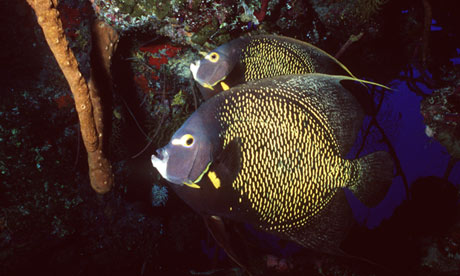
A pair of French angelfish enjoy the coral reef in the Caribbean Sea. Photograph: Marcus Mays for the Guardian
Caribbean coral reefs – which make up one of the world's most colourful, vivid and productive ecosystems – are on the verge of collapse, with less than 10% of the reef area showing live coral cover.
With so little growth left, the reefs are in danger of utter devastation unless urgent action is taken, conservationists warned. They said the drastic loss was the result of severe environmental problems, including over-exploitation, pollution from agricultural run-off and other sources, and climate change.

read more...

9/06/2012

A Great Silence Is Spreading Over the Natural World

Musician and naturalist Bernie Krause has spent 40 years recording over 15,000 species in many of the world's pristine habitats. (Photograph: Courtesy of Hachette Book Group)

Bernie Krause has spent 40 years recording nature's sounds. But such is the rate of species and habitat loss that his tapes may become our only record of the original diversity of life

 "The birds are silent in the woods.
Just wait: Soon enough
You will be quiet too"

- Robert Hass

When musician and naturalist Bernie Krause drops his microphones into the pristine coral reef waters of Fiji, he picks up a raucous mix of sighs, beats, glissandos, cries, groans, tones, grunts, beats and clicks.Musician and naturalist Bernie Krause has spent 40 years recording over 15,000 species in many of the world's pristine habitats.
The water pulsates with the sound of creatures vying for acoustic bandwidth. He hears crustaceans, parrot fish, anemones, wrasses, sharks, shrimps, puffers and surgeonfish. Some gnash their teeth, others use their bladders or tails to make sound. Sea anemones grunt and belch. Every creature on the reef makes its own sound.
But half a mile away, where the same reef is badly damaged, he can only pick up the sound of waves and a few snapping shrimp. It is, he says, the desolate sound of extinction.

read more...

8/24/2012

Sea life 'facing major shock'

Life in the world's oceans faces far greater change and risk of large-scale extinctions than at any previous time in human history, a team of the world's leading marine scientists has warned. The researchers from Australia, the US, Canada, Germany, Panama, Norway and the UK have compared events which drove massive extinctions of sea life in the past with what is observed to be taking place in the seas and oceans globally today.
Three of the five largest extinctions of the past 500 million years were associated with global warming and acidification of the oceans -- trends which also apply today, the scientists say in a new article in the journal Trends in Ecology and Evolution.
Other extinctions were driven by loss of oxygen from seawaters, pollution, habitat loss and pressure from human hunting and fishing -- or a combination of these factors.

read more...

1/04/2012

Bees being turned into 'zombies' by parasite

Honey bees are abandoning their hives and being turned into “zombies” by a deadly fly parasite in their stomachs.
The parasite makes the bees flee their hives and then walk round and round in circles before dying. It also makes them seek out bright lights.
The parasite lays its’ eggs inside the abdomen of the honey bee. About a week after the bee dies, the pupae emerge from the throats and heads of the dead bees.

read more...

11/17/2011

The European Honeybee Crisis

FORGET about the recession, there's another crisis plaguing Europe. And lawmakers are so worried, they're quoting Einstein.
European lawmakers have voted to urge the EU to top up funding for the beekeeping sector. Picture: Ross Schultz Supplied
Bothered by spiking mortality rates for bees, Europe's parliamentarians have voted overwhelmingly to urge the EU to provide more funding for the beekeeping sector.
MEPs voted 534 in favour, with 16 against and 92 abstentions, to support research and development in veterinary medicine to save the declining bee population, while also enforcing legislation on killer pesticides.
"Beekeeping is crucial for our society as pollination plays an essential role in preserving biodiversity and maintaining sustainable European agriculture and food security," said Hungarian Socialist Csaba Tabajdi, who drafted the resolution.
"Albert Einstein once said that without bees, man would live no more than four years," he added.
read more...

2/06/2011

Oysters disappearing worldwide

AFP/Getty Images/File – A survey of oyster habitats around the world has found that the succulent mollusks are disappearing fast …
WASHINGTON (AFP) – A survey of oyster habitats around the world has found that the succulent mollusks are disappearing fast and 85 percent of their reefs have been lost due to disease and over-harvesting.
Most of the remaining wild oysters in the world, or about 75 percent, can be found in five locations in North America, said the study published in BioScience, the journal of the American Institute of Biological Sciences.
An international team of researchers led by Michael Beck of the Nature Conservancy and the University of California, Santa Cruz, examined the condition of native oyster reefs in 40 ecoregions, including 144 bays.
"Oyster reefs are at less than 10 percent of their prior abundance in most bays (70 percent) and ecoregions (63 percent)," said the study.
"They are functionally extinct -- in that they lack any significant ecosystem role and remain at less than one percent of prior abundances in many bays (37 percent) and ecoregions (28 percent) -- particularly in North America, Australia and Europe."

read more...

1/04/2011

US sees massive drop in bumblebees

WASHINGTON — Weakened by inbreeding and disease, bumble bees have died off at an astonishing rate over the past 20 years, with some US populations diving more than 90 percent, according to a new study.
The findings are of concern because bees play a crucial role in pollinating crops such as tomatoes, peppers and berries, said the findings of a three-year study published in the Proceedings of the National Academy of Sciences (PNAS).
Similar declines have also been seen in Europe and Asia, said Sydney Cameron, of the Department of Entomology and Institute for Genomic Biology at the University of Illinois, the main author of the study.

read more...

12/16/2010

Polar bears: On thin ice? Extinction can be averted

Polar bears were added to the threatened species list nearly three years ago when their icy habitat showed steady, precipitous decline because of a warming climate. But it appears the Arctic icons aren't necessarily doomed after all, according to results of a study published in this week's issue of the journal Nature.
The findings indicate that there is no "tipping point" that would result in unstoppable loss of summer sea ice when greenhouse gas-driven warming rises above a certain threshold.

read more...
 
Copyright © 2018 Great Red Comet-Earth Science Chronicles • All Rights Reserved.
Template Design by BTDesigner • Powered by Blogger
back to top