Featured Story

Mangroves move inland as seas rise

Adapting to the damaging effects of climate change, plants are gradually moving to where temperatures are cooler, rainfall is greater, f...

Showing posts with label Solar News. Show all posts

8/18/2015

Solar activity is declining - what to expect?

Is Earth slowly heading for a new ice age? Looking at the decreasing number of sunspots, it may seem that we are entering a nearly spotless solar cycle which could result in lower temperatures for decades. “The solar cycle is starting to decline. Now we have less active regions visible on the sun’s disk,” Yaireska M. Collado-Vega, a space weather forecaster at NASA’s Goddard Space Flight Center, told Phys.org.
But does it really mean a colder climate for our planet in the near future? In 1645, the so-called Maunder Minimum period started, when there were almost no sunspots. It lasted for 70 years and coincided with the well-known “Little Ice Age”, when Europe and North America experienced lower-than-average temperatures. However, the theory that decreased solar activity caused the climate change is still controversial as no convincing evidence has been shown to prove this correlation.
Helen Popova, a Lomonosov Moscow State University researcher predicts that if the existing theories about the impact of solar activity on the climate are true, then this minimum will lead to a significant cooling, similar to the one during the Maunder Minimum period. She recently developed a unique physical-mathematical model of the evolution of the magnetic activity of the sun and used it to gain the patterns of occurrence of global minima of solar activity and gave them a physical interpretation.
“Given that our future minimum will last for at least three solar cycles, which is about 30 years, it is possible that the lowering of the temperature will not be as deep as during the Maunder Minimum,” Popova said earlier in July. “But we will have to examine it in detail. We keep in touch with climatologists from different countries. We plan to work in this direction.”
The solar cycle is the periodic change in the Sun’s activity and appearance like changes in the number of sunspots. It has an average duration of about 11 years. The current solar cycle began on in January 2008, with minimal activity until early 2010. The sun is now on track to have the lowest recorded sunspot activity since accurate records began in 1750. The long-term decline in solar activity set in after the last grand solar maximum peaked in 1956.
But according to Collado-Vega, the current minimum in the number of sunspots doesn’t mean that the sun won’t show us its violent nature in the coming years.
“There is a development for coronal holes, due to the reconfiguration of the sun’s magnetic field, that bear the well-known high-speed streams. These high-speed streams have the ability to cause strong geomagnetic storms at Earth, and changes to the radiation environment in the inner magnetosphere,” Collado-Vega noted.
Coronal holes are regions with lower density and temperatures in the sun’s outer atmosphere, known as the corona. The sun contains magnetic fields that arch away from areas in the corona that are very thin due to the lower levels of energy and gas, which cause coronal holes to appear when they do not fall back. Thus, solar particles or solar wind escape and create a lower density and lower temperature in that area.
The existing fleet of spacecraft studying the sun includes the Solar Dynamics Observatory (SDO), the Solar and Heliospheric Observatory (SOHO) and the Solar Terrestrial Relations Observatory (STEREO), which provide continuous solar observations that are currently enhancing our knowledge about sun’s corona. And if that’s not enough, a new NASA probe named Solar Probe Plus is being developed to revolutionize our understanding of solar phenomena. Significantly, the mission, with a planned launch in mid-2018, will fly closer to the sun than any previous spacecraft. Its primary science goals are to trace the flow of energy and understand the heating of the solar corona and to explore the physical mechanisms that accelerate the solar wind and energetic particles. This would definitely improve future solar activity forecasts and help us more accurately predict the impact that the features on the sun have on our planet.

Phys.org
read more...

6/15/2010

NASA Warns of Devastating Solar Storm near 2013

National power grids could overheat and air travel severely disrupted while electronic items, navigation devices and major satellites could stop working after the Sun reaches its maximum power in a few years.
Senior space agency scientists believe the Earth will be hit with unprecedented levels of magnetic energy from solar flares after the Sun wakes “from a deep slumber” sometime around 2013, The Daily Telegraph can disclose.
Scientists believe it could damage everything from emergency services’ systems, hospital equipment, banking systems and air traffic control devices, through to “everyday” items such as home computers, iPods and Sat Navs.


NASA Warns of Coming Solar Storms
read more...

9/16/2009

Large Sunspot Detected on Far Side

A big sunspot appears to be growing on the far side of the sun. Yesterday, the National Solar Observatory's GONG network detected helioseismic echoes from the sunspot's gathering magnetic field. Today, NASA's STEREO-B spacecraft is beaming back images of an active region peeking over the sun's far-eastern limb - exactly where GONG data predicted it would be. "I believe this is a large active region belonging to new Solar Cycle 24. 

The sun's rotation should turn it toward Earth for direct viewing on Sept. 20th." Until then, the sunspot number remains pegged at zero. Why? Because farside sunspots do not count. Back in the 19th century when the sunspot number was invented, astronomers had no way of monitoring events on the farside of the sun, so no provision was made for adding farside spots to the total. NASA has two spacecraft (STEREO-A and -B) maneuvering for a 360 degree view of the entire sun, and by the year 2011 no sunspot will escape their detection. [site note: Due to earth's position, the spring and autumn (September 22) equinoxes are the most dangerous times for a solar plasma strike that could take down the power grid. It will be especially so in 2012.
read more...

4/16/2009

Where are all the sunspots?

The Sun currently emits less radio noise THAN AT ANY POINT SINCE 1955. The solar wind pressure is currently LOWER THAN AT ANY OTHER RECORDED TIME (NASA first kept track in the 1960's). More galactic cosmic rays (GCRs) bombard the Earth now THAN AT ANY OTHER RECORDED TIME (due to the low solar wind pressure). This means you're soaking up an extra dose of GCRs if you fly in an airplane or live at a very high altitude. Satellites are currently experiencing less atmospheric drag than normal, resulting in greater orbital stability with less fuel expended for station-keeping. Since 2004, we've had 602 sunspot-free days. The typical Solar Minimum lasts for 485 days. 91 days in 2009 have been sunspot-free
read more...

5/13/2008

Erupting Solar Prominence

SOLAR ERUPTIONS
Astronomers are monitoring an unusually active prominence on the sun's eastern limb. Even veteran observers are impressed, using words like "amazing" and "jaw-dropping" to describe the activity they have seen. One onlooker described the fountain-like eruptions as "volcanic in appearance."

Amateur astronomers in Europe and North America witnessed fountains of hot, magnetized gas surging over the eastern edge of the sun. "My hard drive is full of movies," says Didier Favre of Brétigny sur Orge, France, who counted no fewer than seven eruptions.

Veteran observer Pete Lawrence of Selsey, UK, took the picture above. "This is the first time I've ever seen material moving visually away from the surface of the Sun," he says.


UPDATE: Observers are reporting a sunspot (or proto-sunspot) emerging from the direction of yesterday's prominence: #1, #2, #3.
read more...

3/26/2008

Solar Activity on the Rise

Breaking Earth News
SOLAR ACTIVITY ALERT: With little warning, three big sunspots have materialized and on March 25th one of them (989) unleashed an M2-class solar flare. This is the biggest flare of the year and it signals a significant increase in solar activity. "It's March Madness," says Greg Piepol who photographed the three sunspots from his backyard observatory in Rockville, Maryland:


LISTEN: During the M2-flare, radio astronomer Thomas Ashcraft heard a curious "heaving sound" coming from the loudspeaker of his 21 MHz radio telescope in New Mexico: listen. "It was a Type II solar radio burst," he explains. The burst was generated by a shock wave at the leading edge of a CME produced by yesterday's explosion: movie.

NOAA forecasters estimate a 50% chance of more M-flares during the next 24 hours.
read more...

2/07/2008

Images of the Solar Eclipse

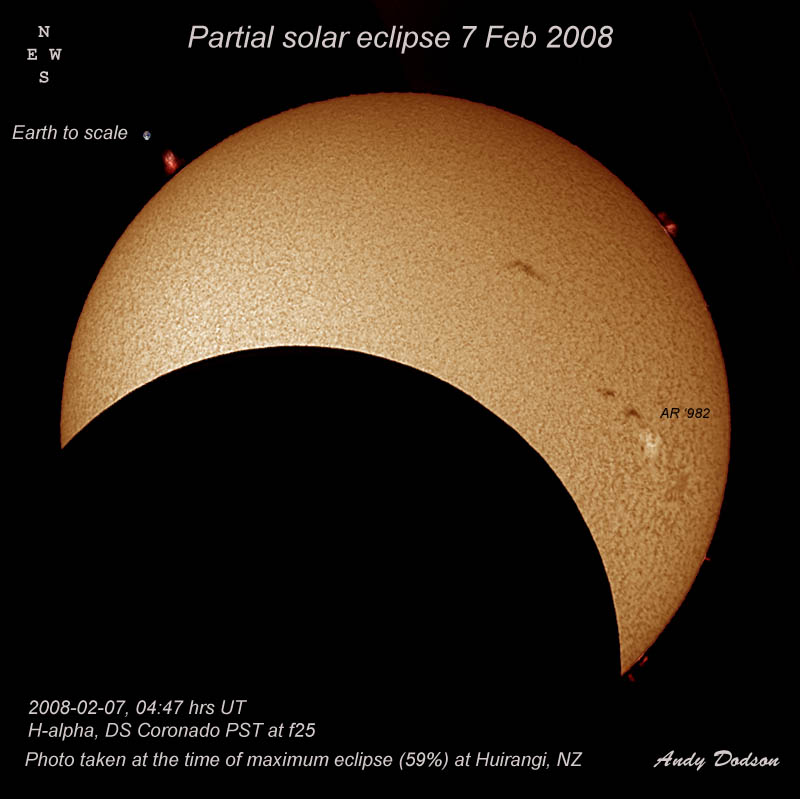
SOLAR ECLIPSE: This morning, the Moon passed in front of the sun, off-center, producing a partial solar eclipse visible from Antarctica, New Zealand and parts of Australia. Amateur astronomer Andy Dodson sends the following from Huirangi, New Zealand:

Meanwhile at the South Pole, "the ambient temperature was -58 degrees F with a wind chill of -90," reports Dave Feldt who braved the elements to take these pictures from the Amundsen-Scott South Pole Station. "I used my digital camera fitted with a filter homemade from two layers of aluminized mylar."

read more...

2/06/2008

Solar Eclipse Visible on Feb 7th

SOLAR ECLIPSE: On Thursday, Feb. 7th, the Moon will pass in front of the Sun, producing a solar eclipse over New Zealand, most of Antarctica and parts of Australia: map, timetables. It is not a total eclipse; the Moon will only partially cover the solar disk. Nevertheless, the event promises some beautiful moments. For instance, the partially-eclipsed Sun will dapple the ground with crescent-shaped sunbeams. Observers in New Zealand and Australia should look in the shadows of leafy trees for this lovely phenomenon. On the barren slopes of Antarctica, scientists and explorers can produce the same effect by letting the sun shine through, say, the latticework of a snowshoe.


Click to view an animated map of the eclipse

It is dangerous to stare directly at a partial eclipse because the exposed portion of the Sun is as blindingly bright as usual. Backyard astronomers with safely-filtered solar telescopes may, however, point their optics at the Sun and watch the mountainous lunar limb glide across the fiery stellar surface. The best views of all are reserved for an remote stretch of the Antarctic where the Moon will pass dead-center in front of the Sun without fully covering it. A thin layer of star will poke out all around the Moon producing a vivid "ring of fire" or annular eclipse. Stay tuned for upcoming photos.

read more...

1/08/2008

Sunspot Is Harbinger Of New Solar Cycle

Image: The first official sunspot belonging to the new Solar Cycle 24 is shown in the northeast quadrant of the Sun. The large sunspot region just south of the equator is part of the waning Solar Cycle 23. (Credit: NOAA. Original image courtesy of NSO/AURA/NSF)

Breaking Solar News

ScienceDaily (Jan. 8, 2008) — A new 11-year cycle of heightened solar activity, bringing with it increased risks for power grids, critical military, civilian and airline communications, GPS signals and even cell phones and ATM transactions, showed signs it was on its way late Thursday when the cycle's first sunspot appeared in the sun's Northern Hemisphere, NOAA scientists said.

"This sunspot is like the first robin of spring," said solar physicist Douglas Biesecker of NOAA's Space Weather Prediction Center. "In this case, it's an early omen of solar storms that will gradually increase over the next few years."

A sunspot is an area of highly organized magnetic activity on the surface of the sun. The new 11-year cycle, called Solar Cycle 24, is expected to build gradually, with the number of sunspots and solar storms reaching a maximum by 2011 or 2012, though devastating storms can occur at any time.


read more...

12/31/2007

Solar Activity Anew

Breaking Solar News
SOLAR ACTIVITY ALERT
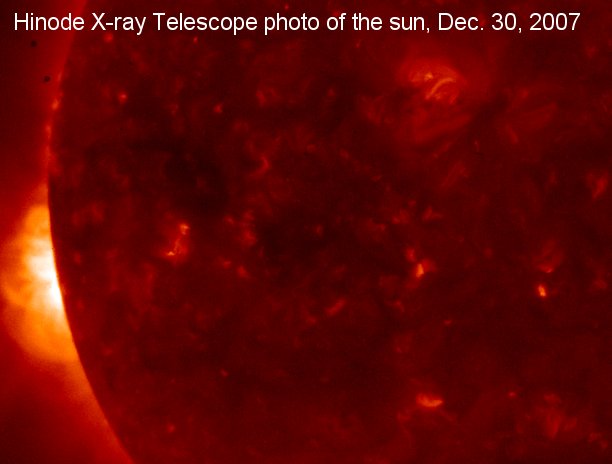
The New Year could begin with a bang--or rather a solar flare. A sunspot hidden just behind the sun's eastern limb has unleashed two X-ray flares and a bright CME (coronal mass ejection) in the past 24 hours. This activity could signal the return of large sunspot 978, which has spent the last two weeks transiting the far side of the sun. Today or tomorrow, the sun's rotation should carry the active region over the limb and into view from Earth; then we can evaluate its potential for more flares and CMEs.

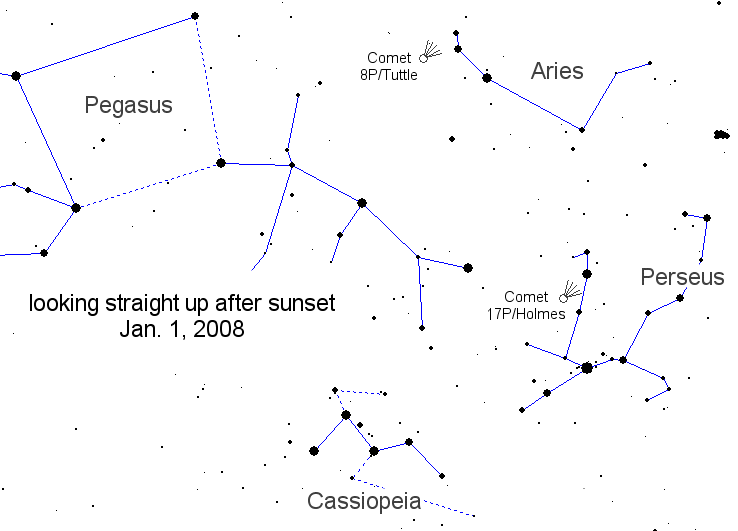
Update: Comet 8P/Tuttle
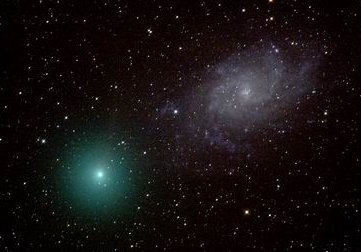
Last night, Comet 8P/Tuttle passed by spiral galaxy M33. It was, well... a picture is worth a thousand words:

"The emerald-colored comet and M33 were a fantastic late Christmas gift for me," says Gerald DeShirlia who photographed the encounter from his drive way in Wimberley, Texas, using a 7-inch refracting telescope and a Canon 20D digital camera.

Now Comet 8P/Tuttle is heading toward Earth. On Jan. 1st and 2nd it makes its closest approach to our planet--only 24 million miles away. The emerald-colored comet will brighten to a predicted magnitude of 5.8, visible to the unaided eye from dark-sky sites and a fine target for backyard telescopes. sky map.
read more...

7/26/2007

Sun Loses Its Spots As Solar Cycle 23 Bottoms With A Cold Wet Southern Winter

The latest image of the Sun from SOHO. To See more of the Sun Click here. Credit: NASA/ESA.

Boulder CO (SPX) Jul 25, 2007
While sidewalks crackle in the summer heat, NASA scientists are keeping a close eye on the sun. It is almost spotless, a sign that the Sun may have reached solar minimum. Scientists are now watching for the first spot of the new solar cycle to appear. The 11 year long solar cycle is marked by two extremes, solar minimum and solar maximum. Solar minimum is the period of least solar activity in the solar cycle of the sun. During this time sunspot and solar flare activity diminishes, and often does not occur for days at a time.
NOAA's Space Environment Center, Boulder CO, forecasts that the next solar cycle should begin in March 2008 and should peak in late 2011 or mid 2012.
read more...

7/11/2007

Sun's in the clear over global warming, says study

Breaking Earth News
Photo: Sun shines over The Concorde Obelisque in Paris, July 2006

Scientists on Wednesday said that the rise in global temperatures that has been detected over the past two decades cannot be blamed on the Sun, a theory espoused by climate-change sceptics.

British and Swiss researchers looked at data for radiation from the Sun, levels of which can cool or warm our planet's atmosphere. They factored in a cycle which solar radiation goes through peaks and troughs of activity over a period of about 11 years. Writing in Proceedings of the Royal Society A, a journal of Britain's de-facto academy of sciences, the team said that the Sun had been less active since 1985, even though global temperatures have continued to rise. "Over the past 20 years, all the trends in the Sun that could have had an influence on the Earth's climate have been in the opposite direction to that required to explain the observed rise in global mean temperatures," they write. The study is co-authored by Mike Lockwood of Britain's Rutherford Appleton Laboratory and Claus Froehlich of the World Radiation Centre in Switzerland. The overwhelming consensus among scientists is that human activity is to blame for the rise in global temperatures. In its latest report, issued this year, the UN's Intergovernmental Panel on Climate Change (IPCC) said that this warming is already affecting the climate system.
read more...

4/28/2007

New video reveals major sun eruption

Photo: A still image taken from the new video of a Dec. 13, 2006 solar flare.

A new movie from the Japanese Hinode spacecraft is one of the most detailed glimpses of a solar flare ever made and has helped scientists see what's behind the colossal eruption.

The striking video, released this week, shows a major flare that lifted off the sun Dec. 13, 2006. The flare erupted from a sunspot catalogued as number 930.

read more...

4/27/2007

Solar Sunburn

Breaking Solar News
Image: From Northern Oklahoma College Enid Campus Observatory
The dark areas on the sun's surface are new sunspots imaged through an observatory in Enid, Okla.
The Associated Press
Transportation sector grapples with solar flare forecast
WASHINGTON (Apr 26, 2007)
The peak of the next sunspot cycle will come in late 2011 or early 2012, potentially affecting airline flights, communications satellites and electrical transmissions. But forecasters can't agree on how intense it will be
read more...

4/12/2007

Major Solar Eruption: Virtually Unreported by Western Press

Solar News Alert
If you haven't heard about the major solar event happening now it is because the Western media is strangely silent about the event.

NASA has issued a communication about the event that plays down the importance of what is happening.

Who would have thought that Russian scientists and press are more apt to discuss events likely to influence our lives than the media in the west?

The largest electromagnetic energy emission in the last 30 years has been recorded on the Sun, the Shternberg State Astronomy Institute said on Thursday. This energy outburst may damage equipment of space satellites, the scientists say. Doctors warn that the emission is dangerous for those afflicted with cardiovascular illnesses as well as for healthy people.


Scientists at the Shternberg Astronomy Institute of the Moscow State University have reported record-high emissions of electromagnetic energy on the Sun, the biggest since the 1970s. Over the past few days, the volume of sun radiation, or X9, has exceeded the normal level 1,000-fold. The scientists call this phenomenon an anomaly and say that the Sun is now in a stage when sunspots, sources of high electromagnetic radiation, are unusual.
read more...

4/06/2007

Space Storm Disrupted GPS

Solar News
April 05, 2007
"Now we are concerned more severe consequences will occur during the next solar maximum," said engineering professor Paul Kintner

Scientists confirm that GPS services were impacted by a December 2006 solar eruption. Solar radio bursts can have a significant effect on global positioning systems (GPS). Solar flares have also been known to cause power outages and disrupt satellite functions. Forecasters from the National Oceanic and Atmospheric Administration observed two solar flares on December 5 and 6, 2006, which occurred during a solar minimum when solar activity is supposed to be much calmer. However, these solar radio bursts were powerful enough to stop receivers from reading the GPS signal on the entire sunlit side of the Earth, and "… produced as much as 10 TIMES MORE RADIO NOISE THAN THE PREVIOUS RECORD." "In December, we found the effect of GPS receivers were more profound and widespread than we expected. Now we are concerned more severe consequences will occur during the next solar maximum."
read more...

3/26/2007

Dazzling new images reveal the 'impossible' on the Sun

Solar News
March, 2007
Photo: S-shaped magnetic loops such as this one on the Sun are more likely than loops of other shapes to unleash radiation and charged particles, which can damage satellites around Earth. Hinode's X-Ray Telescope took this image.

The restless bubbling and frothing of the Sun's chaotic surface is astonishing astronomers who have been treated to detailed new images from a Japanese space telescope called Hinode.

The observatory will have as dramatic an impact on our understanding of the Sun as the Hubble Space Telescope has had on our view of the universe beyond, scientists told a NASA press conference in Washington, DC, US, on Wednesday.
Continue

read more...

1/26/2007

High Solar Activity On Far Side Of Sun

Breaking Solar News
Jan 26, 2007
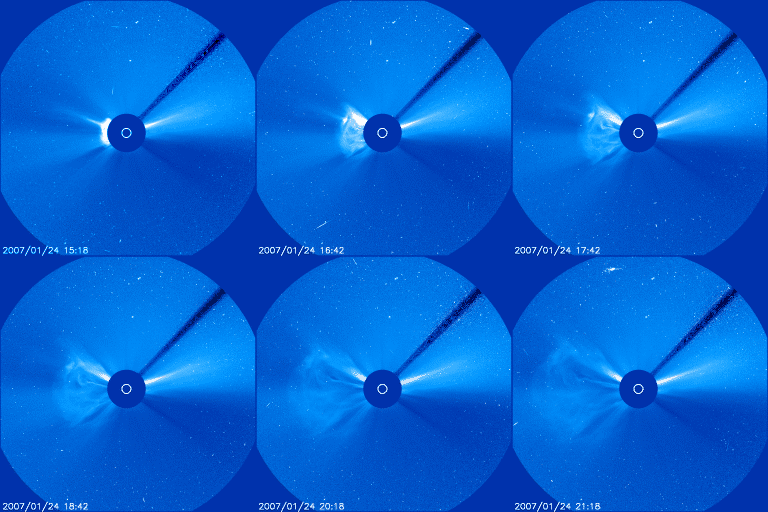
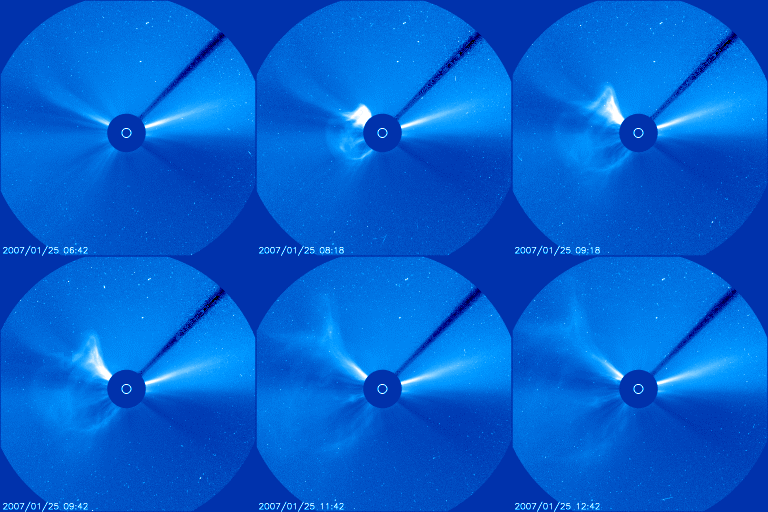
AROUND THE CORNER? Yesterday,something on the far side of the sun exploded, hurling a bright coronal mass ejection (CME) into space:

This is the second day in a row that a CME has rocketed into view from behind the sun's eastern limb (movies: Jan. 24, Jan. 25). An active sunspot must be lurking just around the corner. It should appear in a few days when the sun's rotation carries that part of the sun into view. Stay tuned for solar activity. Very Latest Soho Images

News Source: Spaceweather.com

read more...

1/24/2007

The Sun Explodes While Comet McNaught Shines


Image: Solar Activity for Jan 24, 2007

View the Animated footage of this huge solar flare


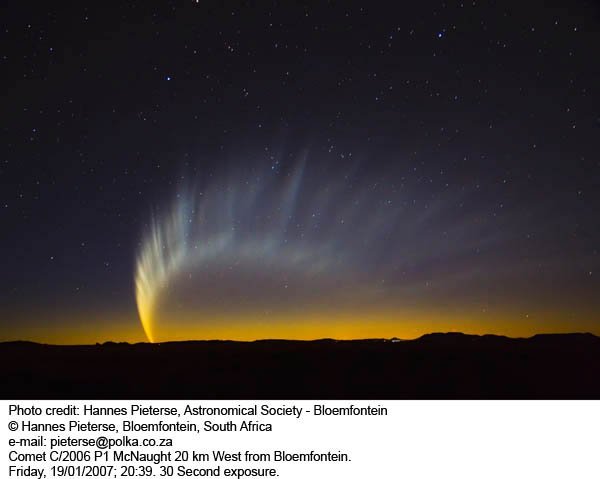
COMET MCNAUGHT: Just another typical night in New Zealand--stars, clouds, an airplane and the brightest comet in 40 years! Last night on the island of Wairarapa, photographer Chris Picking made this movie of Comet McNaught setting in the west:


Comet McNaught is visible from all parts of the Southern Hemisphere. No finder chart is required--simply look west after sunset. "What a spectacle!" says Hannes Pieterse of Bloemfontein, South Africa. "The mammoth tail stretches all the way past Venus: image."
read more...

12/15/2006

Solar Bursts Sending Shock Waves Across Atmosphere

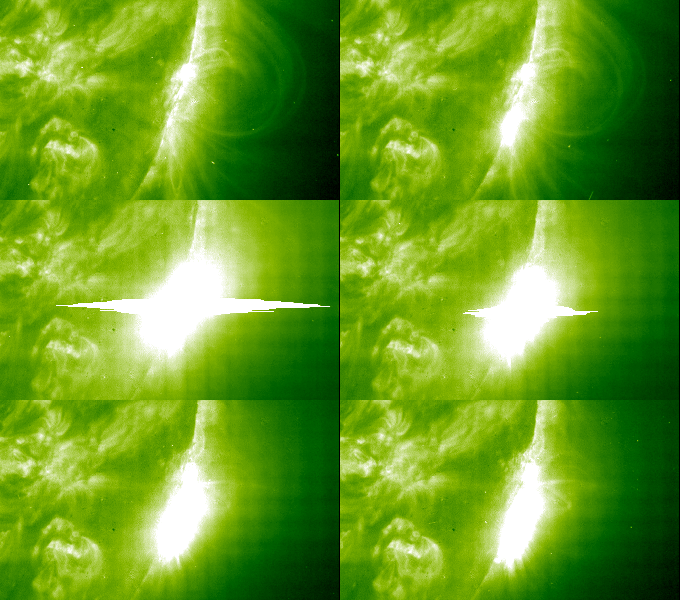
MORE TO COME? A coronal mass ejection (CME) hit Earth yesterday and sparked a strong display of auroras. Another CME may be on the way. An X1-flare from sunspot 930 on Dec. 14th probably hurled a new cloud in our direction. (Confirmation from SOHO is pending.) If so, it would arrive on Dec. 16th and re-energize geomagnetic activity. Stay tuned to GRC for further updates!
SOHO


SOLAR RADIO BURSTS: The latest X-flare from sunspot 930 (an X1.5 explosion at 22:15 UT on Dec. 14th) sent shock waves billowing through the sun's atmosphere. Those waves produced a cacophany of shortwave radio emissions. Thomas Ashcraft recorded some of them using his radio telescope in New Mexico: listen.

Above: A spectrogram of solar radio bursts on Dec. 14th. Courtesy: NASA's Radio Jove Program and the University of Florida Radio Observatory (UFRO).
read more...
 
Copyright © 2018 Great Red Comet-Earth Science Chronicles • All Rights Reserved.
Template Design by BTDesigner • Powered by Blogger
back to top