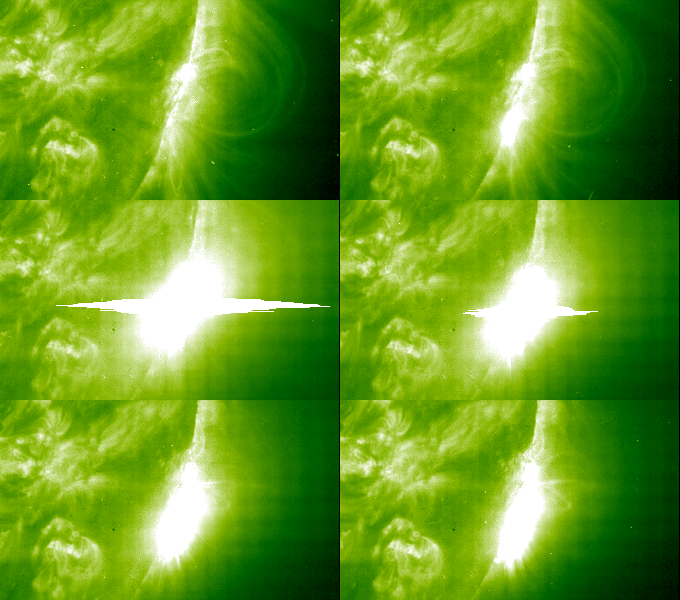
But does it really mean a colder climate for our planet in the near future? In 1645, the so-called Maunder Minimum period started, when there were almost no sunspots. It lasted for 70 years and coincided with the well-known “Little Ice Age”, when Europe and North America experienced lower-than-average temperatures. However, the theory that decreased solar activity caused the climate change is still controversial as no convincing evidence has been shown to prove this correlation.
Helen Popova, a Lomonosov Moscow State University researcher predicts that if the existing theories about the impact of solar activity on the climate are true, then this minimum will lead to a significant cooling, similar to the one during the Maunder Minimum period. She recently developed a unique physical-mathematical model of the evolution of the magnetic activity of the sun and used it to gain the patterns of occurrence of global minima of solar activity and gave them a physical interpretation.
“Given that our future minimum will last for at least three solar cycles, which is about 30 years, it is possible that the lowering of the temperature will not be as deep as during the Maunder Minimum,” Popova said earlier in July. “But we will have to examine it in detail. We keep in touch with climatologists from different countries. We plan to work in this direction.”
The solar cycle is the periodic change in the Sun’s activity and appearance like changes in the number of sunspots. It has an average duration of about 11 years. The current solar cycle began on in January 2008, with minimal activity until early 2010. The sun is now on track to have the lowest recorded sunspot activity since accurate records began in 1750. The long-term decline in solar activity set in after the last grand solar maximum peaked in 1956.
But according to Collado-Vega, the current minimum in the number of sunspots doesn’t mean that the sun won’t show us its violent nature in the coming years.
“There is a development for coronal holes, due to the reconfiguration of the sun’s magnetic field, that bear the well-known high-speed streams. These high-speed streams have the ability to cause strong geomagnetic storms at Earth, and changes to the radiation environment in the inner magnetosphere,” Collado-Vega noted.
Coronal holes are regions with lower density and temperatures in the sun’s outer atmosphere, known as the corona. The sun contains magnetic fields that arch away from areas in the corona that are very thin due to the lower levels of energy and gas, which cause coronal holes to appear when they do not fall back. Thus, solar particles or solar wind escape and create a lower density and lower temperature in that area.
The existing fleet of spacecraft studying the sun includes the Solar Dynamics Observatory (SDO), the Solar and Heliospheric Observatory (SOHO) and the Solar Terrestrial Relations Observatory (STEREO), which provide continuous solar observations that are currently enhancing our knowledge about sun’s corona. And if that’s not enough, a new NASA probe named Solar Probe Plus is being developed to revolutionize our understanding of solar phenomena. Significantly, the mission, with a planned launch in mid-2018, will fly closer to the sun than any previous spacecraft. Its primary science goals are to trace the flow of energy and understand the heating of the solar corona and to explore the physical mechanisms that accelerate the solar wind and energetic particles. This would definitely improve future solar activity forecasts and help us more accurately predict the impact that the features on the sun have on our planet.
Phys.org