|
Kadir van Lohuizen / NOOR
A langouste diver in front of Carti Cohabita. Residents of the island are scheduled to evacuate in August.
|
Featured Story
Mangroves move inland as seas rise
Adapting to the damaging effects of climate change, plants are gradually moving to where temperatures are cooler, rainfall is greater, f...

Showing posts with label Rising Sea Levels. Show all posts
Showing posts with label Rising Sea Levels. Show all posts
8/22/2012
Migration in the Americas: On the run from water in Panama

9/15/2011
Rising sea levels could take economic toll on California beaches
 |
| Homeowners along Broad Beach in Malibu have been building huge sandbag walls reinforced with truckloads of boulders to stem damage caused by rising seas and stormy tides. (Al Seib / Los Angeles Times) |
As climate change warms and expands the ocean, increased storm damage and erosion will narrow the state's beaches and diminish their appeal to both tourists and wildlife, economists at San Francisco State predict.
7/20/2011
UN security council to consider climate change peacekeeping
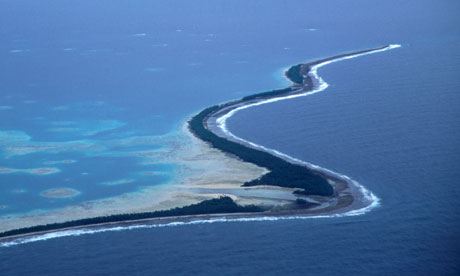 |
| Small island states, which could disappear as sea levels rise, want the UN security council to intervene. Photograph: Matthieu Paley/ Matthieu Paley/Corbis |
Small island states, which could disappear beneath rising seas, are pushing the security council to intervene to combat the threat to their existence.
There has been talk, meanwhile, of a new environmental peacekeeping force – green helmets – which could step into conflicts caused by shrinking resources.
9/22/2009
Islands warn of extinction at UN climate week
 NEW YORK — As world leaders gather for key climate talks here, small island nations Monday warned they were running out of time with rising seas threatening to wipe them off the map.
Spread across the Earth's oceans, the planet's tiniest members grouped together in the Alliance of Small Islands States (AOSIS) are hoping to make their voices heard 100 days before UN-hosted climate talks in Copenhagen.
UN chief Ban Ki-moon and former British prime minister Tony Blair also urged governments around the world to publicly commit themselves to tackling global warming as they opened New York Climate Week.
"We need a commitment for a fair deal in Copenhagen," Ban said.
Climate negotiators have spent the last two years working toward a make-or-break summit in Copenhagen this December, expected to ink new targets for global emissions beyond 2012, when the Kyoto Protocol expires.
5/23/2009
Coastal populations at risk as climate changes
 Africa
A trend has emerged since the mid-1970s where storms tend to last longer and be more intense, with a strong correlation to the rise in tropical sea surface temperature. Several large African cities are at risk from rising sea levels and intense storms, experts warn. In such low-income urban centres, infrastructure is often non-existent or ill-maintained, while storm-water drainage infrastructure is often outdated and inadequate. In sub-Saharan Africa, storm surge zones are concentrated in Madagascar, Mauritania, Mozambique and Nigeria. These countries alone account for about half (53 percent) of the total increase in the region’s surge zones resulting from sea level rise and intensified storms. "Coastal flooding has started to be of concern in the last 10 to 15 years. Now, a few times each year, there are people who wake up in water." In 50 years, some coastal towns in Mozambique will disappear if nothing is done - such as Nacala, Beira, Quelimane and Mahajanga. Coastal agriculture, in terms of extent of croplands, will be affected 100 percent in Nigeria, 66.67 percent in Ghana, and 50 percent in Togo and Equatorial Guinea. Mauritania is experiencing the impact of a changing climate exemplified by a steadily creeping desert and other extreme weather events. It is one of the countries likely to be worst affected by intensified storm surges. An average 78 million people worldwide are exposed each year to tropical cyclone wind hazard and another 1.6 million to storm surges. In terms of economic exposure, an annual average of $1,284 billion in GDP is exposed to tropical cyclones. "Currently 10 percent of the world’s total population (over 600 million people) and 13 percent of its urban population (over 360 million people) live on the 2 percent of the world’s land area that is less than 10m above sea level, known as the Low Elevation Coastal Zone."
5/13/2009
Disaster looming on rising sea levels
 MANADO--Rising sea levels that could wipe whole nations off the map and displace scores of millions of people are being overlooked in global climate
Major emitters are pushing for greenhouse gas emissions cuts that are too low to prevent devastating sea rises, representatives said at the World Ocean Conference in Indonesia's Manado city.
"Dealing with environmental refugees will have a much more serious impact on the global economy and global security in fact than what wars have ever done to this planet," said Rolph Payet, a presidential adviser from the African island nation of the Seychelles.
Other nations under threat from even small rises in sea levels include the Pacific island states of Kiribati and Tuvalu, while heavily populated low-lying areas such as Bangladesh's coastline would also go under.
3/18/2009
Sea Level Rise Due To Global Warming Poses Threat To New York City
Global warming is expected to cause the sea level along the northeastern U.S. coast to rise almost twice as fast as global sea levels during this century, putting New York City at greater risk for damage from hurricanes and winter storm surge, according to a new study led by a Florida State University researcher.
 "The northeast coast of the United States is among the most vulnerable regions to future changes in sea level and ocean circulation, especially when considering its population density and the potential socioeconomic consequences of such changes," Yin said. "The most populous states and cities of the United States and centers of economy, politics, culture and education are located along that coast."
Image: New York Skyline (Credit: iStockphoto/Klaas Lingbeek- Van Kranen)
read more...
 "The northeast coast of the United States is among the most vulnerable regions to future changes in sea level and ocean circulation, especially when considering its population density and the potential socioeconomic consequences of such changes," Yin said. "The most populous states and cities of the United States and centers of economy, politics, culture and education are located along that coast."
Image: New York Skyline (Credit: iStockphoto/Klaas Lingbeek- Van Kranen)
11/18/2008
NASA: Measuring up sea level change
 ScienceDaily (Nov. 10, 2008) — A NASA-led research team has used satellite data to make the most precise measurements to date of changes in the mass of mountain glaciers in the Gulf of Alaska, a region expected to be a significant contributor to global sea level rise over the next 50-100 years.
The study's authors found that the annual ice mass lost from glaciers in the Gulf of Alaska has been 84 gigatons annually, about five times the average annual flow of the Colorado River through the Grand Canyon and equal to the entire amount of water in the Chesapeake Bay.
Image Above: The mass changes of the Gulf of Alaska glaciers are computed from the Gravity Recovery and Climate Experiment (GRACE) inter-satellite rate data from April 2003 through September 2007. Using space-borne gravity measurements to assess glacier mass balance NASA scientists determine mass variations along the Gulf of Alaska. Areas of deep blue like the areas around Glacier Bay and the Yakutat Icefield represent significant mass loss where inland areas of dark gray represent slight mass gains. (Credit: NASA)
5/12/2008
Virginia should plan for the coming sea-level rise
 Virginia, USA
A big problem today and one that grows larger over time is that the whole low-lying coastal system along the Chesapeake Bay shoreline is going under water. From Old Point Comfort through the Back River drainage, up through Poquoson, across to Gloucester and Guinea Neck, and on to Mathews, Stingray Point and Windmill Point – all of this land is getting wetter and wetter. Flooding will increase in the coming decades. Hampton Roads is faced with at least a 2-foot relative sea-level rise over the next century. This increase will unfold gradually with each storm reaching higher and higher until, by 2106, the equivalent of that 2006 Columbus Day nor'easter would produce more flooding than they saw from Hurricane Isabel. This 2-foot rise is the most conservative estimate of what is headed their way, due to global warming that has already happened. Without arguing the source of the warming, without talking about "what ifs" of future greenhouse-gas emissions, they are stuck with this 2-foot relative sea-level rise. They will have to raise houses higher and higher after every one of the future storms. Roads leading to those houses will also have to be raised higher and higher to allow fire and police access. Utilities, storm-water and sewage systems, ground-water and septic systems – every piece of public infrastructure in those low-lying areas will also have to be fixed at taxpayer expense. Virginia is alone among mid-Atlantic states in not responding to the coming sea-level rise. Maryland and North Carolina have produced high-resolution, digital flood maps and are working on solutions. Most state governments along the East Coast have plans to address coastal flooding from the higher tides that are coming.
RELATED NEWS
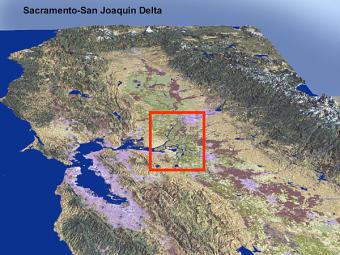 CALIFORNIA - If left unchecked, the rising sea levels caused by global climate change could leave Stockton under water, California's Lt. Governor warned Thursday. "Yes, Delta water has come up six inches over the last century. And if you go 56 inches, we're in deep water right here." In addition to capricious flooding and spells of drought driven by climate change, he said California laws have to account for things such as levees and how water is stored in natural aquifers that supply drinking water. Making choices that arise from climate change, people often take a short-term approach, brushing aside solutions that set a positive course for years to come, he said. "I think that's really wrong. We need to think of the generations ahead."
 5/05/2008
Australia's climate change victims
 Breaking Earth News
Image: Masig Island, one of the low-lying islands of the Torres Strait
TORRES STRAIT, AUSTRALIA - Like Kiribati and Tuvalu, the islands of the Torres Strait are slowly being submerged. But unlike their Pacific neighbours, the plight of their inhabitants is being overlooked. Islanders in the Torres Strait, which lies between the far north-eastern tip of the Australian mainland and Papua New Guinea, have witnessed higher tides in recent years than they have ever seen before. Houses, roads and graveyards have been flooded, and the locals believe they know the reason: climate change. About 7,000 people live on the islands, 18 of which are inhabited. Abnormally high tides are not the only phenomenon that the islanders have observed. The seasons are shifting, and the land is eroding. Birds' migration patterns have altered, and the turtles and dugongs (sea cow) that are traditionally hunted for meat have grown scarce. People are no longer certain when to plant their crops: cassava, yams, sugarcane, bananas, sweet potato. "We see the big trees near the beach, like the wongai trees, falling down. The seagrass that the dugongs eat, you used to find long patches of it, but not any more. The corals are dying, and the sand is getting swept away and exposing the rock. "We were taught by our grandfathers and fathers to read the sky and forecast the weather. You see this cloud, you go to your garden and start planting. You see that cloud, it's time to clear your land. But nowadays the weather is unpredictable." Others report that the rainy season is rainier, the dry season drier. And the marine life is behaving oddly. "We were told there's an iceberg melting and the level of the sea is going up. We don't know how we will survive. Our island is only flat, and the water seems to be taking all the land."
4/17/2008
Forecast for big sea level rise
 Earth Changes
Sea levels could rise by up to one-and-a-half metres by the end of this century, according to a new scientific analysis.
This is substantially more than the Intergovernmental Panel on Climate Change (IPCC) forecast in last year's landmark assessment of climate science.
Sea level rise of this magnitude would have major impacts on low-lying countries such as Bangladesh.
The findings were presented at a major science conference in Vienna.
The research group is not the first to suggest that the IPCC's forecast of an average rise in global sea levels of 28-43cm by 2100 is too conservative.
The IPCC was unable to include the contribution from "accelerated" melting of polar ice sheets as water temperatures warm because the processes involved were not yet understood.
Melt water
The new analysis comes from a UK/Finnish team which has built a computer model linking temperatures to sea levels for the last two millennia.
Glaciers 'flowing faster'

"But by the end of the century, we predict it will rise by between 0.8m and 1.5m.
"The rapid rise in the coming years is associated with the rapid melting of ice sheets."
Where will all these people go? - There are 10 million victims threatened by the annual floods that ravage Bangladesh. Millions of these find temporary shelter in the rivers, on islands that emerge when water levels drop during the summer. Experts say a third of Bangladesh's coastline could be flooded if the sea rises one metre in the next 50 years, creating an additional 20 million Bangladeshis displaced from their homes and farms. This is about the same as Australia's population. "Bangladesh is already facing consequences of a sea level rise, including salinity and UNUSUAL height of tidal water." It is unclear how the government could feed, house or find enough clean water for vast numbers of climate refugees in a country of 140 million people crammed into an area of 55,500 sq miles. In a taste of what the future might look like, Bangladesh suffered two massive floods and a cyclone last year that together killed about 4,500 people, made at least two million homeless and destroyed 1.8 million tons of rice.
3/24/2008
Venice plans to raise its sinking buildings as sea levels rise
 Italy
ItalyVenice has become increasingly vulnerable over time, suffering more than 50 significant floods between 1993 and 2002 and sinking about 23 centimeters over the course of the 20th century.
ROME, March 21, 2008 (AFP) - Venice is considering a plan to raise its buildings to counter rising sea levels, an Italian press report said on Friday.
The operation, codenamed "Rialto," would take around a month per building if each structure is raised by eight centimetres (three inches) a day.
Implementation began in 2003 and is scheduled to end in 2012 at an expected cost of some four billion euros (six billion dollars).The lagoon city has been increasingly vulnerable to flooding, having suffered more than 50 episodes of "acqua alta" (high water) between 1993 and 2002.
The worst recorded high waters were in November 1966 when the city was under 1.94 metres (6.3 feet) of water, as the rest of Italy was also battling heavy floods2/03/2008
Antarctic ice riddle keeps sea-level secrets
 Antarctica
Click the Image for more on rising seas
Any thaw could raise sea levels faster than UN projections. Even if a fraction melted, Antarctica could damage nations from Bangladesh to Tuvalu in the Pacific and cities from Shanghai to New York. It has enough ice to raise sea levels by 57 metres (187 ft) if it melted over thousands of years. Some island nations, such as the Maldives in the Indian Ocean, are building defences costing millions of dollars and want to know how high to build. East Antarctica is the world's deep freeze with no sign of a thaw. Temperatures were about minus 15 Celsius (5.00F) at the height of the Antarctic summer. Most experts said it is still impossible to model how the ice will react. "The crux of this problem is that we are moving into an era where WE ARE OBSERVING CHANGES IN THE CLIMATE SYSTEM THAT HAVE NEVER BEFORE BEEN SEEN IN HUMAN HISTORY." Most of the projected sea-level rise by 2100 will be because water in the oceans expands as it warms, with little being added by the ice sheets. Beyond 2100, sea-level rises are likely to go on for centuries. "IN THE LONG RUN WE ARE IN TROUBLE"...Greenland is close to a 'tipping point'," or an irreversible meltdown that would last hundreds of years. Greenland has enough ice to raise world sea levels by 7 metres if it all vanished.
1/26/2008
Tuvalu struggles to hold back tide
 Video: The King Tide hits the islands of Tuvalu
The BBC's David Shukman takes a closer look at how the Pacific Ocean is reclaiming the remote Tuvalu islands.
The South Pacific
The fragile strips of green that make up the small islands of Tuvalu are incredibly beautiful but also incredibly vulnerable.

Factors behind sea level rise
The group of nine tiny islands in the South Pacific only just break the surface of the ocean - but for how much longer?
During a King Tide, which is what the islanders call the highest tides of the year, waves rolling off the ocean can have a devastating effect.
The islands' main road is submerged and nearby homes are threatened by the rising waters.
"We have never seen this in the past," a concerned resident tells me. "We have never seen water coming in this far."
Tuvalu struggles to hold back tide
The South Pacific
The fragile strips of green that make up the small islands of Tuvalu are incredibly beautiful but also incredibly vulnerable.
Factors behind sea level rise
The group of nine tiny islands in the South Pacific only just break the surface of the ocean - but for how much longer?
During a King Tide, which is what the islanders call the highest tides of the year, waves rolling off the ocean can have a devastating effect.
The islands' main road is submerged and nearby homes are threatened by the rising waters.
"We have never seen this in the past," a concerned resident tells me. "We have never seen water coming in this far."
1/22/2008
Rising Seas Threaten China's Sinking Coastal Cities

China
Sea levels off Shanghai and other Chinese coastal cities are rising at an alarming rate, leading to contamination of drinking water supplies and other threats, China's State Oceanic Administration reported Thursday. Waters off the industrial port city of Tianjin, 60 miles (100 kilometers) southeast of Beijing, rose by 7.72 inches (20 centimeters) over the past three decades, the administration said.
Earth Changes

Sea levels off Shanghai and other Chinese coastal cities are rising at an alarming rate, leading to contamination of drinking water supplies and other threats, China's State Oceanic Administration reported Thursday. Waters off the industrial port city of Tianjin, 60 miles (100 kilometers) southeast of Beijing, rose by 7.72 inches (20 centimeters) over the past three decades, the administration said.
Seas off the business hub of Shanghai have risen by 4.53 inches (11.5 centimeters) over the same period, the report said.
Administration experts said global climate change and the sinking of coastal land due to the pumping of ground water were the major causes behind rising water levels.
1/20/2008
Warning on rising Med Sea levels
 Earth Changes
The level of the Mediterranean Sea is rising rapidly and could increase by up to half a metre in the next 50 years, scientists in Spain have warned. Levels have been rising since the 1970s with the rate of increase growing in recent years. If the trend continues it would have "very serious consequences" in low-lying coastal areas even in the case of a small rise, and "catastrophic consequences" if a half-metre increase occurred. Scientists noted that sea temperatures had also risen significantly by 0.12 to 0.5C since the 1970s. The findings are consistent with other investigations into the effects of climate change. Last month, a study by the Intergovernmental Panel on Climate Change said the world's sea levels could rise twice as much this century as UN climate scientists had previously predicted. The IPCC predicts a maximum sea level rise of 81cm (32in) this century.
1/05/2008
Raging seas carve away sand cliffs
 Skywatch-Media News
 Special Report
Australia
Image: Beach goers check out the erosion of sand from Sunshine Beach as huge seas persist on the Sunshine Coast. Photo: Geoff Potter/n19426 Photo by Geoff Potter
Beach Erosion
King tides have broken across the sand bar north of Pincushion Island in the Maroochy River for the second time in a year, but the Sunshine Coast is cautiously optimistic its sandy beaches will withstand the claws of the raging sea.
The tides are carving sand cliffs at Sunshine Beach and North Shore but the sand shifts are less obvious across other beaches.
Wild waves close beaches
BIG seas and treacherous conditions closed three beaches and caused a string of minor rescues across the Hastings this week.
11/27/2007
Ocean swallows town
Breaking Earth News
Videos on Demand
Brazil, S.A.
The Brazilian town of Atafona, is being swallowed by the ocean as rising temperatures speed up erosion.
Professor Gilberto Ribiero, Coordinator of the Atafona project at the Institute of Geoscience, saying: (Portuguese)
"Global warming is a fact, it is happening and nature is responding. One of the answers, for example, is the strengthening of the winds. The winds are stronger and in this region (Atafona) we saw here, the winds provoke the waves which will provoke sea erosion."
Atafona's oldest resident Belita Pedra, saying: (Portuguese)
"This house right there, is my sixth home. The ocean took everything away. People had very good houses here, but the ocean swept everything away. My son-in-law became tired of building houses and losing the
read more...
Videos on Demand
Brazil, S.A.
The Brazilian town of Atafona, is being swallowed by the ocean as rising temperatures speed up erosion.
Researchers say a total of 183 buildings have been destroyed and the Marine lighthouse moved twice in the past 30 years.
Deborah Lutterbeck reports.Featured Speakers:
"Global warming is a fact, it is happening and nature is responding. One of the answers, for example, is the strengthening of the winds. The winds are stronger and in this region (Atafona) we saw here, the winds provoke the waves which will provoke sea erosion."
"This house right there, is my sixth home. The ocean took everything away. People had very good houses here, but the ocean swept everything away. My son-in-law became tired of building houses and losing the
11/13/2007
Low-lying states open meet to battle rising seas
 Breaking Earth News
Arabian Sea
MALE (AFP) — Dozens of small island nations opened talks in the Maldives Tuesday to draft a strategy to combat rising sea levels threatening their countries.
Delegates from 26 low-lying nations -- including Tonga, Micronesia and Kiribati -- are meeting to craft a proposal ahead of global climate change talks in Indonesia in December.
"Time is running out for us to ensure the survival of our future generation," Maldivian President Maumoon Abdul Gayoom said at the opening of the two-day meeting.
The low-lying nations fear not enough is being done to cut the greenhouse gases that are said to cause global warming, which forecasters warn could melt the ice caps and raise sea levels sharply before the end of the century.
Gayoom said climate change was about much more than the environment, science or politics: "It is fundamentally an issue about people."
The tidal surges experienced on 80 of the Maldives' 200 inhabited islands earlier this year were "a grim reminder of the devastating tsunami of 2004 and a clear warning of future disasters", he said.
Subscribe to:
Posts (Atom)