 Rwenzori Mountains (Uganda) (AFP) -
In swirling snow, John Medenge prods a thin ice bridge over a crevasse
with an iron-tipped spear, guiding climbers scaling the steep glacial
wall using crampons and axes.
Rwenzori Mountains (Uganda) (AFP) -
In swirling snow, John Medenge prods a thin ice bridge over a crevasse
with an iron-tipped spear, guiding climbers scaling the steep glacial
wall using crampons and axes.
"We are the last
few who will climb on the ice, it is going so fast," said Medenge,
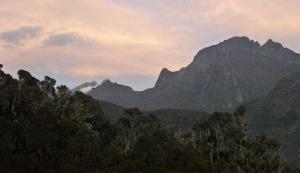
after scaling the treacherous ridge up Mount Stanley, part of the
dramatic Rwenzori mountain range straddling the border between Uganda
and Democratic Republic of Congo.
At
5,109 metres (16,763 feet), Stanley's jagged peak is the third highest
mountain in Africa, topped only by Mount Kenya and Tanzania's iconic
Kilimanjaro.
But experts warn
the ice is melting at "disturbing" rates, and that within two decades
Africa's equatorial peaks will be bare rock, impacting agriculture and
tourism.
"Every year the ice grows smaller," 54-year old Medenge added, who has been climbing the range since a teenager.
Ancient
Greek geographer Ptolemy in Alexandria wrote of the snow-capped
Rwenzoris around the second century AD, dubbing the mysterious peaks the
"Mountains of the Moon", and identifying them as a source of the mighty
White Nile.
- 'Canary in the mine' -
But
after centuries of wonder at the spectacle of snow on the equator, the
ice is vanishing, bringing with it multiple challenges.
"The
melting glaciers are another warning sign, a 'canary in the mine' of
mankind's inability to contain climate change and its negative
consequences," said Luc Hardy of Pax Arctica, an organisation that
promotes awareness of the impact of climate change, and who led an
expedition in January to the mountains.
"The
melting of this unique African glacier is a major threat to local
communities, with the obvious loss of sustainable water supplies," said
Hardy, a French-American explorer and a vice-president of the
environmental Green Cross group.
Reduced
glacial river flows are already impacting agricultural production and
cutting the output of hydroelectric power plants, said Richard Atugonza,
from the Mountain Resource Centre at Uganda's Makere University.

"It can be a big problem in the future for the region, with the river ecology already changing," Atugonza said.
Just
a handful of kilometres (miles) north of the equator, the mist-covered
Rwenzoris -- meaning "rain-maker" in the local Bakonzo language --
stretch for some thousand kilometres squared (386 square miles), and
include several short glaciers, though on many peaks remaining ice is
now tiny patches.
British-American
explorer Henry Morton Stanley was the first Westerner to sight the ice
in 1889, but the dramatic sight of glinting snow in hot sunshine is
fading fast, with maps showing the ice has shrunk from some seven square
kilometres (2.7 square miles) when they were first climbed in 1906, to
just a single square kilometre (a third of a square mile) today.
Fifty
years ago, the glacier once began a stone's throw from the cliff-top
Elena camp, where mountaineers shiver in basic huts before making a
pre-dawn attempt to scale Stanley's peaks.
Now the ice lies almost an hour's tough scramble up a steep track on loose rocks along sheer cliffs.

- Impacting agriculture and tourism -
Mountain
guides say the local king sends elders to sacrifice chickens and goats
at the foot of the mountains to appease the gods that live in the peaks,
to stem the vanishing ice.
"Global
warming was not caused by people here, but it is harming us," Baluku
Stanley said, chairman of one of the main trekking companies, the
community-run Rwenzori Mountaineering Services.
"Of course when the ice goes it will affect tourism, even though trekking in the valleys is amazing," he added.
Spectacular
valleys with fantastical vegetation akin to a fairy story -- including
bizarre twisted trees draped in near luminous green lichen, giant
lobelia plants and heather some five metres (15 feet) tall -- offer
extraordinary trekking, even once the ice has gone.
Elephant,
leopards, monkeys and chimpanzees hide in the thick lower jungle, while
at higher altitudes, colourful birds endemic to the range swoop over
the vast bogs that line the valleys.
But
in higher reaches, new climbing routes have to be found, as the
retreating ice make old paths unusable, with dangling rusting ladders
once used to climb onto the glaciers now ending dangerously in mid-air.
The
peaks offer some of the only proper ice climbing in Africa, attracting
mountaineers from across the world to the challenging climb, though
numbers reaching the top summits are tiny compared to those scaling
peaks in neighbouring Kenya or Tanzania.
"The
Rwenzoris are some of the most exciting glacier trekking and climbing
I've done, rivalling peaks in Europe and South America," said Paul
Drawbridge, a keen British mountaineer on an eight-day expedition to
climb Stanley.
"It is such a shame to think that any children I may have will never get to see the ice-capped peaks."