Featured Story

Mangroves move inland as seas rise

Adapting to the damaging effects of climate change, plants are gradually moving to where temperatures are cooler, rainfall is greater, f...

Showing posts with label asteroids. Show all posts

3/06/2012

Asteroid 2012 DA14 heads for Earth next year

Scientists are predicting that the asteroid 2012 DA14 has a small chance of colliding with Earth in eleven months. Watch the skies in February 2013!
According to RT, NASA has confirmed that the 60 meter (or 197 feet) asteroid, which was spotted by Spanish stargazers in February this year, may be on a collision course to Earth. 
The scientists suggest confronting this asteroid with either big guns or, more strangely, with paint. The problem with either option is that there is no time to build a spaceship for the operation. A spaceship could either shoot the asteroid down or simply crash into it - this would either break it into pieces or throw it off course. 
read more...

1/20/2010

Preparing for an asteroid strike

THE sight of the solar system's biggest planet being battered by the broken remains of a comet in 1994 left a vivid reminder of our own planet's vulnerability. The scars that remained after the series of giant impacts on Jupiter were more prominent even than its great red spot, and remained visible for months.

This dramatic spectacle was enough to loosen government purse strings, and the funding has supported telescope surveys to hunt down asteroids that could wallop us. A decade and a half after comet Shoemaker-Levy 9 smashed into Jupiter, those surveys have catalogued more than 80 per cent of the near-Earth asteroids larger than 1 kilometre across.

Now we have seen the results of the first exercise ever to test plans for what to do if an asteroid is on collision course with Earth (see Asteroid attack: Putting Earth's defences to the test)Movie Camera, and they do not inspire confidence. We still have a long way to go before we can say we are prepared for this cosmic threat.
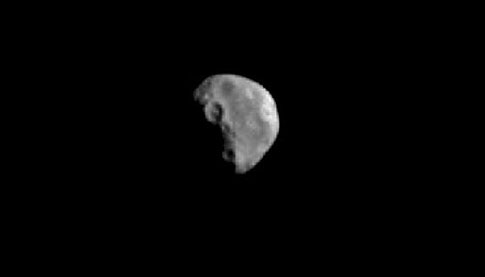
Improved early-warning capabilities are one cost-effective solution.

There are telescopes on the drawing board that could find objects as small as 140 metres in diameter. That's a big advance on what we can do now, even if objects 30 to 50 metres across are more numerous and therefore arguably more dangerous.
read more...

9/02/2009

British plan to tackle asteroids

A team of British scientists and engineers is developing plans for a spacecraft that could stop large asteroids from hitting the Earth. The 10-tonne "gravity tractor" would deflect any orbiting rocks years before any potential collision could happen. The device would rely on the force of gravity. The tractor would intercept the asteroid from just 48m away and exert a small gravitational force on it, pulling the rock towards it. The pair would then embark on a slightly different orbit, away from the Earth. It could possibly be powered using solar panels. "We have done quite a lot of design work on this with the European Space Agency and we believe this would work just as well on a big solid iron asteroid as well as other types." However, the device would have to be launched at least 15 years before any predicted collision and would need a team to monitor it from the ground during this time. However, the idea is still in its early stages and the company says a prototype is some way off from being built. NASA has recorded 1,068 known "Potentially Hazardous Asteroids", however there are thousands more estimated to be present in space.
read more...

2/11/2008

Another Asteroid Passes Close to Earth

On Tuesday, February 5, 2008 an SUV sized asteroid passed between the Earth and the moon. Asteroid 2008 CT1 came within135,000 kilometers ( 84,000 miles) of Earth, only a third of the distance to the moon. The asteroid was discovered only two days before its close approach to Earth, spotted by the Lincoln Near Earth Asteroid Research (LINEAR) project, using robotic telescopes located at New Mexico’s White Sands Missile Range. The asteroid’s size is estimated between 8 - 15 meters.

While this asteroid seems small, we know that even small rocks can be devastating. Last September, a meteorite estimated at .2 – 2 meters wide created a crater 13 meters wide in Peru. The cause of the Tunguska Event of the early 20th Century is now believed to be a 35m rock that never even touched the ground. It’s believed that it exploded a few miles above the ground, creating a shockwave that devastated the landscape below.
read more...
 
Copyright © 2018 Great Red Comet-Earth Science Chronicles • All Rights Reserved.
Template Design by BTDesigner • Powered by Blogger
back to top