"Fukushima is the biggest industrial catastrophe in the history of
mankind," Arnold Gundersen, a former nuclear industry senior vice
president, told Truthout shortly after a 9.0 earthquake in Japan caused a
tsunami that destroyed the cooling system of Tokyo Electric Power
Company's (TEPCO) nuclear plant in Fukushima, Japan.
While this statement might sound overdramatic, Gundersen may be right.
Several nuclear reactor meltdowns in the plant, which at the time
forced the mandatory evacuations of thousands of people living within a
15-mile radius of the damaged power plant, persist, and experts like
Gundersen continue to warn that this problem is not going to go away.
"The fuels are now a molten blob at the bottom of the reactor."
The March 11, 2011, 9.0 earthquake that destroyed the cooling systems
at TEPCO led to hydrogen explosions and reactor meltdowns, and has left
exposed highly radioactive materials that Gunderson says are the root
of the problem. For now, there is no solution in sight.
"Fukushima has three nuclear reactors exposed and four fuel cores
exposed," Gundersen said. "You probably have the equivalent of 20
nuclear reactor cores because of the fuel cores, and they are all in
desperate need of being cooled, and there is no means to cool them
effectively."
This persistent problem reared its head yet again in December 2015, when TEPCO was forced to deal with a
massive amount of highly radioactive water generated by having to cool the reactors and exposed fuel cores Gundersen mentioned.
TEPCO must now transfer between 200 and 300 tons of groundwater into
highly contaminated reactor buildings, having been unable to devise an
effective plan for keeping the groundwater from continuing to flow under
the plant.
To see more stories like this, visit "Planet or Profit?"
"The problem is how to keep it cool," Gundersen explained. "They are
pouring in water and the question is what are they going to do with the
waste that comes out of that system, because it is going to contain
plutonium and uranium. Where do you put the water?"
The company has repeatedly come under fire for
periodically dumping large amounts of radioactive water into the Pacific Ocean.
Even though the plant has not been online since it was largely
destroyed in 2011, fission products such as uranium continue to generate
heat, and therefore require cooling.
"The fuels are now a molten blob at the bottom of the reactor," Gundersen said.
Shortly after the plant was damaged, TEPCO announced that they had
experienced a "melt through," which means a melted reactor core had
melted through some layers beneath it.
"Most of the time TEPCO seems to be firefighting, discovering leaks here and unexpectedly high levels of radiation there."
That left several highly radioactive blobs that now have water on top
of them, hence causing the water to become extremely radioactive. This
process of cooling the cores has now generated hundreds of thousands, if
not millions, of tons of highly radioactive water that then must be
dealt with somehow.
Dr. M.V. Ramana, a
physicist and lecturer at Princeton University's Program on Science and Global Security and the
Nuclear Futures Lab, says the problem is the lack of a real long-term plan for addressing the issue.
"Most of the time TEPCO seems to be firefighting, discovering leaks
here and unexpectedly high levels of radiation there," Ramana told
Truthout. "In part, this is because TEPCO's plans do not account for the
many possibilities of failure and putting in place backup safety
systems."
Dr. Helen Caldicott, an author and anti-nuclear advocate who has
established several foundations that
oppose the use of nuclear power and weapons and depleted uranium
munitions, told Truthout that the situation in Fukushima is "very
serious indeed."
"There is no way to prevent the radioactive water [from] reaching the
western shores of the North American continent and then circulating
around the rest of the Pacific Ocean," Caldicott said. "At the moment,
it seems like this is going to occur for the rest of time."
Massive Releases of Radiation
A declassified report from the US Nuclear Regulatory Commission
written immediately after the disaster began states that massive amounts
of radiation from the plant were released into the atmosphere early on.
The report
states:
"25% of the total fuel in unit 2 released to the atmosphere ... 50% of
the total spent fuel from unit 3 was released to the atmosphere, and ...
100% of the total spent fuel was released to the atmosphere from unit
4."
Meanwhile, in December 2015, Japan's NHK news agency
reported alarmingly high spikes in radiation levels underneath the Fukushima plant.
"There are no safe levels of radiation for biological systems."
TEPCO detected levels of radioactive cesium (a material which has a
half-life of 30 years) in water samples that were 4,000 times higher
than data taken the same month one year earlier. The samples also
contained levels of a beta-ray-emitting radioactive substance that were
4,100 times higher than they were from the same period a year earlier.
As Caldicott warned, radiation from Fukushima along the US West Coast is expected to continue to worsen.
According to a
2013 study by the Nansen Environmental and Remote Sensing Center in Norway,
the first radioactive oceanic plume released by Fukushima is likely to
hit the US's West Coast in force in 2017, with levels expected to peak
in 2018. According to the report, the majority of the radioactive
material from the disaster is expected to stay concentrated along the
West Coast through at least 2026.
Even though that plume hasn't yet hit, the spread of radiation has already been substantial. Professor Michio Aoyama of
Japan's Fukushima University Institute of Environmental Radioactivity believes
the amount of radiation that has now reached North America is probably
nearly as much as was spread over Japan during the initial disaster.
A recent Woods Hole study
shows a 50 percent increase in radiation levels 1,600 miles west of San
Francisco, but states that the levels are still far below what the US
government considers dangerous.
However, Caldicott takes issue with what the United States considers a "safe" level of radiation exposure.
"There are no safe levels of radiation for biological systems," she
said. "That terminology is used by the nuclear industry to cover their
inevitable radioactive releases."
Solution?
Ramana believes it could still take decades before the plant's radiation leaks are even contained.
"I think this is going to take a couple of decades," he said. "We are
still in the early years; it hasn't even been five years since the
disaster started. It has been 30 years since Chernobyl and remediation
of that site is still [a] work in progress."
"March 2011 was just the beginning of the disaster, which is still unfolding."
Disconcertingly, Ramana does not believe there is a "true solution"
to the crisis. When asked how TEPCO and the Japanese government are
likely to handle the crisis, he said, "What we will get is TEPCO and
other Japanese authorities muddling through this completely
unprecedented situation."
Ramana pointed out many reasons why he believes people should pay
attention to what is happening in Fukushima, and started by correcting
the belief that the disaster "occurred" and is now over.
"March 2011 was just the beginning of the disaster, which is still
unfolding," he said. "As something that is unfolding, one should be
concerned about how the situation is being managed."
He added that since this is an ongoing crisis, people need to
remember how challenging it is to deal with a nuclear accident, and that
this should cause people to be skeptical of "safe" nuclear power more
broadly.
"TEPCO's actions should serve as evidence that organizations that
seek to profit from running a nuclear plant are not always the best ones
to manage accidents or cleanup," Ramana said. "Likewise, its actions
prior to the accident, wherein it made decisions that maximize its
short-term profits while not making decisions that would have promoted
safer operations (or shutting down the reactor), are emblematic of a
number of other utilities, all of whom have conflicting priorities. That
TEPCO is the organization that experienced such a major accident while
others have escaped, at least so far, is at least in part a matter of
luck."
Gundersen told Truthout he had seen data that revealed radioactive
hot spots further away from Fukushima than the radiation from Chernobyl
had reached after that disaster.
"And the amount of radiation in many of them was the amount that
caused areas to be declared no man's land for Chernobyl," he said. "You
can't clean all this up. We still have radioactive wild boar in Germany,
35 years after Chernobyl."
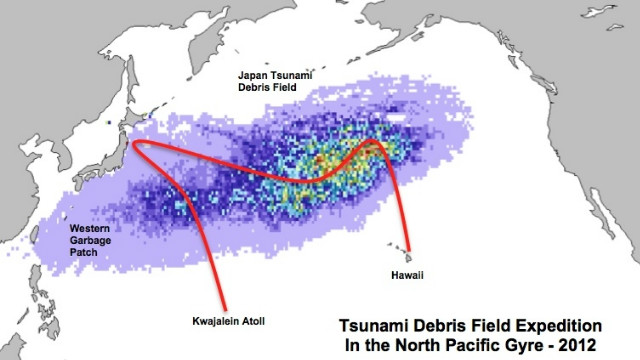
Radioactive water from the Fukushima disaster continues to be released into the Pacific, and spread around the globe.
Of this, Caldicott warned, "There is a system of biological
magnification by orders of magnitude at each step of the food chain:
algae, crustaceans, little fish, big fish." That means that the
radiation's impact on the planet's ecology expands the further it moves
up and across the food chain.
Meanwhile in the United States, the nuclear industry continues apace.
"With Three Mile Island and Chernobyl, and now with Fukushima, you
can pinpoint the exact day and time they started, but they never end."
Nuclear operator Exelon Corporation was among Barack Obama's biggest
campaign donors, and is one of the largest employers in Illinois where
Obama was a US senator. Exelon donated more than $269,000 to his
political campaigns, and Obama appointed Exelon CEO John Rowe to his
Blue Ribbon Commission on America's Nuclear Future.
Yet the Fukushima disaster, which, as Ramana points out, is just
beginning, stands as a reminder of the dire consequences of continuing
to allow the nuclear industry to grow. This reminder will remain with us
indefinitely.
"With Three Mile Island and Chernobyl, and now with Fukushima, you
can pinpoint the exact day and time they started," Gundersen said, "but
they never end."
In Japan, US citizens living there who were located within a 50-mile
radius of the Fukushima plant were required to evacuate. Within the
United States, more than 120 million people live within a 50-mile
evacuation zone of a nuclear plant.
Meanwhile, officials from TEPCO have admitted they are not sure when
their company might be able to solve its multitude of problems, and
begin to reduce the amount of contaminated water at the plant. When it
comes to the nuclear industry, it seems, it is always difficult to
determine when a disaster will end - or if it will end at all.
Image Above: The
Ikata Nuclear Power Plant, which was idled after the 2011 disaster in
Fukushima, in the Ehime prefecture of Japan, January 23, 2014. (Photo:
Ko Sasaki / The New York Times)
Truth Out