In separate studies published this week,
research teams working in Barrow, Alaska announced two discoveries
about the polar air: an unexpected process for depositing mercury
pollution to land and sea, and the highest levels of molecular chlorine
ever detected.
The chlorine finding, published in Nature Geoscience, is simply weird — it's too early to conclude what it means for the environment on a broader scale.
But the mercury finding, ,
is worrisome. Mercury is a potent neurotoxin that enters the atmosphere
through coal-burning power plants and other industries, and can be
carried far from its original source. When it enters an ecosystem,
bacteria can transform it into highly toxic methylmercury and that builds up in wildlife; in humans, it has a host of harmful effects including neurological damage to babies in the womb.
The twin papers are another indication
that the Arctic remains an enigma, especially as it changes in response
to global warming.
"There's a lot left to learn — not just
about the Arctic atmosphere but about atmosphere, ocean, sea ice, land,
and snow," said Kimberly Strong, an Arctic expert and atmospheric
physicist at the University of Toronto who was not involved in either
research team.
"We're really just starting to pull
together all the bits of the puzzle, and these two studies are
contributing to that."
Both of the studies relate to a peculiar
process that is one of the strangest things done in the midnight sun,
at least when it comes to atmospheric chemistry. More than 20 years ago,
scientists discovered that something weird was happening to mercury and
ozone levels in the High Arctic air in springtime: in space of just
hours they would suddenly disappear, only to return again hours later.
"At first we thought the instruments
were broken," says Alexandra Steffen, an atmospheric mercury specialist
at Environment Canada who was involved in those early experiments and
the new study published in Nature. "Then it happened again. So then we
started to really say, ok, what is going on here?"
The scientists discovered that bromine, a
chemical component of sea salt found in the snow and ice, is released
into the air where it reacts with sunlight and becomes volatile. It
reacts with mercury and ozone, destroying the ozone and converting the
mercury into a form that can be deposited onto earth.
For the new study published in Nature,
Steffen and a team of researchers led by Christopher Moore and Daniel
Obrist from the Desert Research Institute in Nevada set out to discover
how sea ice dynamics affect this unusual chemistry.
They hauled a mercury-measuring
instrument that was made in Toronto onto the frozen Chukchi Sea off the
coast of Alaska, and then monitored what happened when air masses moved
over channels of open water in the sea ice called "leads."
The usual mercury and ozone depletion
events occurred. But then the levels of both substances would suddenly
spike back up. It happened too quickly to be the result of new clouds of
mercury pollution rolling in from across the sea.
The mercury and ozone were being sucked
down from higher up in the atmosphere as a result of the "leads" in the
sea ice. Leads expose the frigid Arctic air to warmer sea water,
creating turbulence that churns the atmosphere above and draws down a
fresh supply of air where the mercury and ozone have not been depleted
yet.
That means there is more of both
available to undergo the process of being destroyed, in the case of
ozone, or deposited onto the earth's surface, in the case of mercury.
Climate change has radically altered
Arctic sea ice dynamics, creating thinner seasonal ice that is more
susceptible to the creation of leads. It's possible, the researchers
conclude in Nature, that this process is increasing the overall mercury
load in the Arctic.
The next step is to confirm that this
happens elsewhere in the Arctic, says Obrist. "But this certainly has
the potential to refuel the mercury deposition and increase it.
"A changing Arctic can have very unexpected consequences."
The chlorine study published in Nature
Geoscience adds an interesting extra dimension to the story. A research
team led by Greg Huey, an atmospheric chemist at Georgia Tech, went to
Barrow to analyze bromine compounds in the Alaskan air.
But to their shock, the spectrometer
also uncovered molecular chlorine in levels as high as 400 parts per
trillion by volume (meaning for every trillion molecules, 400 were
chlorine). Those are the highest levels reported anywhere in the world,
the study says.
The data "bordered on incredible. We didn't believe it at first," says Huey.
Chlorine is not only highly reactive,
but highly reactive with sunlight, and the levels were measured during
the day. It's unclear where such a massive supply of chlorine is coming
from, though likely its original source is sea salt.
Chlorine, like bromine, reacts with
mercury, oxidizing it and depositing it on earth. It also destroys ozone
and methane. Huey has just finished writing a proposal to study whether
chlorine appears in the atmosphere in other parts of the Arctic. It's
too early to say how chlorine may be affecting the mercury cycle in the
north.
Even after 20 years of Arctic research, Steffen says, every trip north uncovers a new story.
"The Arctic is a rich and wonderful
place, and I hope we make our way to learn what's going on and preserve
it as best we can."
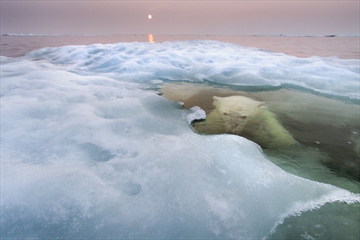
Image: Paul Souders,Torstar News Service
A polar bear is seen under the surface in the frigid Arctic water